Genuine Merz Ultherapy PRIME in Seoul — Treated by a Board-Certified Dermatologist in English
Non-invasive deep lifting targeting the SMAS layer
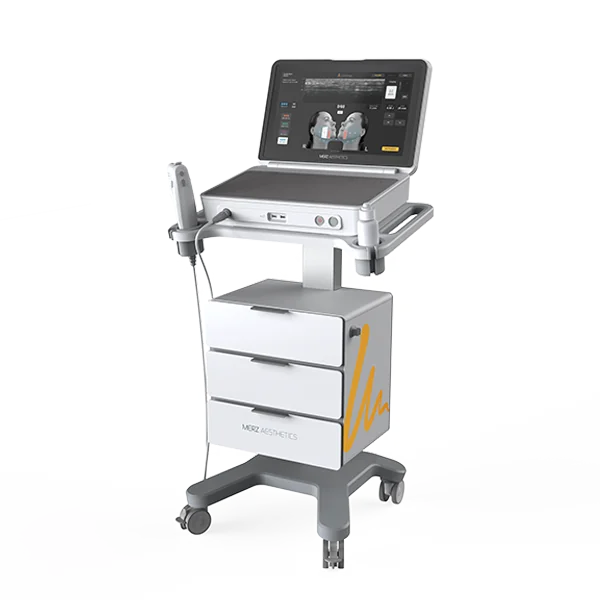
Ultherapy PRIME is Merz’s micro-focused ultrasound for sagging along the jawline and neck, and ABLE Dermatology is listed as a genuine Ultherapy PRIME provider on Merz Aesthetics Korea’s official provider locator (see the listing, in Korean — a listing, not an endorsement). Dr. Jeong Kyungmuk, a board-certified dermatologist, consults and performs Ultherapy himself, in English; one session is usually enough, with results building over 3 months, and swelling may last about 2 weeks. Fees are published as a range in our Treatment Price Guide (lifting: KRW 200,000–3,000,000 per session).
ABLE Dermatology (에이블피부과) · 140 Jungdae-ro, Songpa-gu, Seoul, 4-5F · right in front of Police Hospital Station (Line 3) Exit 4 — turn left from the exit · from Jamsil: Line 8 to Garak Market, then Line 3 for one stop
Medically reviewed by Dr. Jeong Kyungmuk, board-certified dermatologist · Last updated
Are you noticing progressive sagging in your face, neck, and jawline? At ABLE Dermatology, Dr. Jeong Kyungmuk, a board-certified dermatologist, examines you and performs the treatment himself, in English, using a genuine Merz Ultherapy PRIME system. Ultherapy uses high-intensity focused ultrasound (HIFU) to stimulate deep collagen regeneration without needles or incisions.
Ultherapy works by stimulating your own collagen production. HIFU energy reaches the deep layers beneath the skin, including the SMAS layer, where heat makes collagen contract and triggers new collagen formation over about three months. Some tightening may be felt right after treatment, and lifting develops gradually; results usually last about a year, although this varies from person to person. At ABLE Dermatology, we combine Ultherapy PRIME with board-certified dermatological expertise for a treatment plan designed around your skin.
Ultherapy uses HIFU (High-Intensity Focused Ultrasound) technology. HIFU energy is focused at a set depth beneath the skin to create heat, and the layer it mainly reaches depends on the transducer depth: the 4.5 mm transducer reaches the SMAS layer—the deep structural layer responsible for facial contours and skin elasticity—and the deep part of the subcutaneous fat, while the 3.0 mm and 1.5 mm transducers mainly reach the dermis. With age, collagen and elastin in the SMAS layer degrade, which leads to sagging that topical skin care does not reach.
When Ultherapy's HIFU energy reaches the SMAS layer, three changes occur. First, collagen fibers contract instantly when exposed to heat around 60-70°C (140-158°F), producing the tightening felt right after treatment—this is the "Immediate Collagen Contraction" effect. Second, the body's natural healing response is triggered, clearing damaged collagen and stimulating "neocollagenesis" (new collagen formation) over the following weeks. Third, increased blood flow accelerates skin regeneration. Over about three months, these effects may gradually improve skin firmness and facial contours.
Dermal fillers add volume to create contour, and they are gradually absorbed over time. Ultherapy works differently: it stimulates collagen regeneration so that your own tissue becomes firmer. Because the two work in different ways, at ABLE Dermatology we sometimes combine them: Ultherapy for lifting and tightening, and filler for volume where it is needed.
Midface and cheek laxity caused by loss of collagen support. HIFU directly stimulates the SMAS layer for structural lift.
Fine lines and laxity of the neck and chest area. Ultherapy can also be used on these delicate areas.
Loss of jawline definition and submental fullness improve with HIFU stimulation of subplatysmal tissues, creating sharp, defined contours.
Our board-certified dermatologist evaluates skin laxity, skin thickness, facial bone structure, and aesthetic goals. Dr. Jeong consults and treats in English himself. We customize Ultherapy settings—energy level, treatment depth, and target zones—based on your unique anatomy and desired outcome.
Real-time ultrasound imaging (DeepSEE visualization) is used to check the depth of each area, although the depth shown on screen and where the heat actually forms can differ. Treatment follows a systematic, even pattern for a natural-looking result and avoids anatomical danger zones (facial nerve pathways).
Soothing treatments begin immediately to enhance collagen regeneration. Optional complementary therapies (radiofrequency skin tightening, gentle ultrasound therapy) may be recommended. We provide detailed aftercare instructions and international patient support.
Precise, step-by-step process
The face is thoroughly cleansed and a thin layer of ultrasound coupling gel is applied. Our dermatologist maps out treatment zones based on your facial anatomy, marking the areas to be treated.
The Ultherapy handpiece is moved systematically across treatment zones. Real-time ultrasound imaging allows our doctor to view the SMAS layer and set the HIFU focal depth for each area. The entire face, jawline, and neck typically requires 20-40 minutes. Energy and depth are individually adjusted.
A calming serum is applied, and a hydrating mask may be used to minimize inflammation. No bandages or restrictive dressings are needed. Most people can resume makeup and normal activities right away.
Some tightening may be felt on the day of treatment as collagen contracts. Most of the change develops over the following 2-3 months as new collagen forms, and results usually last about a year, although this varies from person to person. Individual variation is normal; factors such as baseline skin quality, age, sun exposure history, and genetics influence the magnitude and duration of improvement.
Many patients have one treatment session. Those with more laxity may choose a second session 6-12 months later. Our board-certified dermatologist will discuss a personalized treatment plan during your consultation.
The number of lines matters, but the right number differs with face size, area and goal, so rather than “as many as possible”, Dr. Jeong Kyungmuk sets a line count that suits the face and divides it across areas at different depths.
| Transducer depth | Main layer reached | Weighted more when |
|---|---|---|
| 4.5 mm | SMAS and the deep part of the subcutaneous fat | Moderate or greater sagging such as the jawline and cheeks, neck sagging — structural lifting |
| 3.0 mm | Upper reticular dermis down to the junction between dermis and subcutaneous fat | Milder sagging, overall firmness of the face and neck |
| 1.5 mm | Papillary and upper reticular dermis | Fine superficial lines and texture, pores that look stretched from lost firmness, thin areas such as the neck and décolleté |
Two-layer treatment with 3.0 mm and 4.5 mm is common, and in some cases 1.5 mm is added for three layers. Because SMAS depth differs from person to person, the treatment is done while checking the depth of each area on the DeepSEE screen, although the depth shown on screen and where the heat actually forms can differ. Because matching the depth on screen matters, dual-handpiece treatment is not automatically better.
For people with little facial fat or a concern about fat loss (cheek hollowing), the line count is kept where possible and the energy is lowered appropriately; when hollowing and sagging occur together, the hollow area is treated only lightly.
Dr. Jeong Kyungmuk, board-certified dermatologist — he examines you and performs the treatment himself, in English.
ABLE Dermatology is listed as an Ultherapy PRIME clinic in Merz Aesthetics Korea's official list of clinics participating in its genuine-product certification program (see the listing, in Korean). This is a list of participating clinics, not a recommendation or endorsement by Merz. Before treatment, you can check whether the device and transducers are genuine (Merz genuine certification program).
Dr. Jeong sets a line count that suits the face and divides it across areas at different depths. Two-layer treatment with 3.0 mm and 4.5 mm is common, and in some cases 1.5 mm is added for three layers. The depth of each area is checked on the DeepSEE screen, although the depth shown on screen and where the heat actually forms can differ.
The published fee range is in the Quick facts above and in the full fee list. The exact fee is set after your consultation.
Most people resume daily activities and makeup right after treatment; swelling may last about two weeks. If you have a flight soon after treatment, let us know your schedule at the consultation and we will advise you.
Message us on WhatsApp. Consultations and day-to-day communication are handled by Dr. Jeong himself. See also the booking guide.
| Treatment | Suited to | Sessions / interval | Recovery |
|---|---|---|---|
| Ultherapy PRIME | Sagging jawline and neck | Usually 1 session (repeat after 6–12 months) | Swelling about 2 weeks |
| Density | Loose skin, loss of firmness | 1 session, once every 6–12 months to maintain | Daily life right after |
| Onda | Fat and sagging along the face and jawline | 3 sessions 2–4 weeks apart (3–6) | Daily life right after |
| Olewave | Tethered tissue, or prefer to avoid heat | Decided at consultation | Almost none |
Sessions, intervals and recovery vary with your skin and are decided at your consultation.
Ultherapy generates heat, so you may feel mild warmth and slight discomfort. There is no incision or injection. Pain sensitivity varies individually, and topical anesthetic can be applied to extremely sensitive areas if needed.
This depends on individual skin elasticity and degree of sagging. Usually a single treatment is done, and for severe sagging a repeat treatment may be performed at 6-12 month intervals.
You may feel some tightness right after treatment, but the lifting effect appears gradually as collagen regeneration progresses over 3 months. Peak results typically appear 2-3 months after treatment.
Ultherapy is non-invasive, so most people can resume daily activities and wear makeup right after treatment, and swelling may last about two weeks.
Yes, we welcome international patients from around the world. Dr. Jeong consults and treats in English himself. With a reservation, treatment can follow your consultation (this may vary by procedure and skin condition). We provide aftercare guidance and accept international payment methods including major credit cards.
We accept major international credit cards (Visa, Mastercard, American Express), Korean debit cards, and Korean Won cash.
With a reservation, treatment can follow your consultation (this may vary by procedure and skin condition).
Yes. Dr. Jeong Kyungmuk, a board-certified dermatologist, examines you and performs the treatment himself, in English.
The clinic is right outside Exit 4 of Police Hospital Station on subway Line 3. From Myeongdong or Hongdae, take the subway and change to Line 3 for Police Hospital Station. From Incheon Airport, airport bus 6300 takes about 1 hour 30 minutes to the Police Hospital stop, a 1-minute walk from the clinic. Other routes are in our airport access guide.
Be able to choose, not be pushed.
For each paper, the note lists only what it supports among the statements on this page. Studies that used the same principle with a device other than ours are marked in the note. Study results come from the people studied; results differ from person to person.
This page is for informational purposes only. Individual results may vary. Please consult with our dermatologist for personalized treatment recommendations.