Potenza RF Microneedling in Seoul
Precision radiofrequency for scars, pores, and skin renewal
Potenza is RF microneedling for acne scars and enlarged pores, and Dr. Jeong Kyungmuk, a board-certified dermatologist, consults and performs it himself, in English. Scars usually need 3–10 sessions, 1–3 months apart; redness lasts 2–3 days and makeup is possible from the next day. Fees are published as a range in our Treatment Price Guide (RF microneedling: KRW 100,000–800,000 per session).
ABLE Dermatology (에이블피부과) · 140 Jungdae-ro, Songpa-gu, Seoul, 4-5F · right in front of Police Hospital Station (Line 3) Exit 4 — turn left from the exit · from Jamsil: Line 8 to Garak Market, then Line 3 for one stop
Medically reviewed by Dr. Jeong Kyungmuk, board-certified dermatologist · Last updated
Acne may be behind you, but the scars it left can still affect how you feel about your skin. Deep boxcar scars, narrow icepick scars and rolling scars that make the surface uneven each need a different approach. Potenza RF Microneedling works on one part of the problem: the abnormally organized collagen in the dermis around a scar, which it remodels gradually.
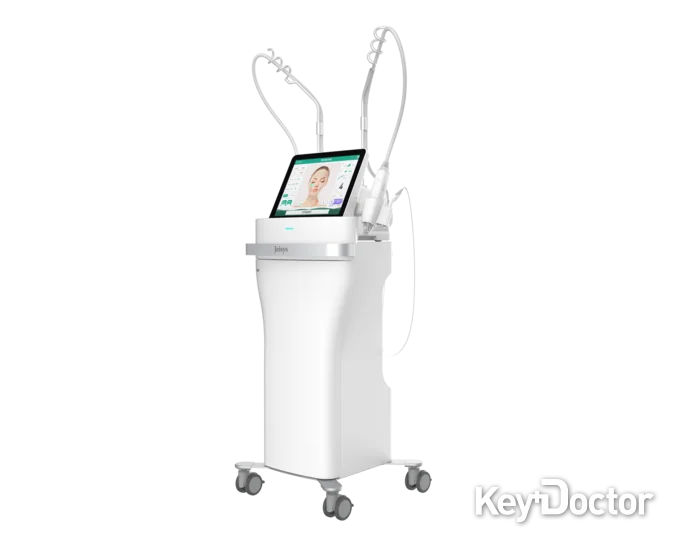
Potenza combines two mechanisms in one device: medical-grade microneedles that create controlled micro-injuries, and radiofrequency (RF) energy delivered through each needle tip. Together they stimulate collagen remodeling, in which disorganized scar tissue is gradually restructured and new collagen is formed. Improvement is gradual, and pore size and skin texture may also change along the way.
For international patients, downtime matters. Surface recovery after Potenza usually takes about 2-3 days, compared with about 5-10 days after ablative CO2 laser. Because Potenza stimulates collagen rather than ablating the surface, the risk of post-inflammatory hyperpigmentation, a common concern in darker skin types, tends to be lower, although it can still occur.
Acne scars fall into three distinct categories, each requiring different treatment strategies. Icepick scars are narrow, deep punctate depressions resembling tiny holes. Boxcar scars have sharply defined edges and a flat bottom, creating a rectangular depression. Rolling scars have soft, undefined edges and wave-like contours. Traditional treatments struggle because they address only the surface; deep scars require energy delivery to the dermal layer where collagen is organized.
Potenza works through a dual mechanism. The microneedles penetrate to the scar base, and RF energy from each needle tip heats the surrounding tissue to 50-70°C, triggering immediate collagen contraction and, more importantly, activating the body's remodeling cascade. Over the following weeks, abnormal scar collagen is enzymatically broken down and replaced with organized, healthy collagen. This dermal remodeling builds slowly and cumulatively with each treatment session. In icepick scars, needle RF alone rarely moves the depression itself, so it is planned together with point treatments such as TCA CROSS and pinhole; in deep, sharp-edged boxcar scars, needle RF on its own can even make the scar look more angular, so it is planned together with treatments that tidy the margin, such as pinhole. Rolling scars, which are particularly amenable to collagen remodeling, are a good fit for this treatment.
Several approaches are used for scars, including these three. CO2 Laser uses ablative energy to vaporize the scar surface and stimulate collagen, with 5-10 days of visible recovery (peeling, redness, possible swelling); post-inflammatory hyperpigmentation can be a concern, especially in darker skin tones. Dermal Fillers fill scars for an immediate cosmetic change, but the effect is temporary because fillers are gradually absorbed. Potenza has about 2-3 days of surface recovery and works through gradual collagen remodeling. At ABLE Dermatology, we sometimes combine Potenza with selective filler: Potenza works on the structure, and filler addresses remaining depth.
Potenza remodels the dermis around icepick, boxcar and rolling scars to even out edges and texture. In icepick scars it is combined with point treatments such as TCA CROSS and pinhole, because needle RF alone rarely moves the depression itself; in deep, sharp-edged boxcar scars it is combined with treatments that tidy the margin, such as pinhole.
RF energy and collagen regeneration tighten skin and reduce pore diameter.
Beyond scars, Potenza improves overall skin quality: fine lines diminish, skin appears more radiant, and texture becomes smoother and more uniform.
Our board-certified dermatologist evaluates scar depth, morphology (icepick/boxcar/rolling), size, location, and your skin type. Dr. Jeong consults and treats in English himself. We create a customized treatment plan: number of sessions, RF settings, and expected outcomes.
Potenza is applied systematically across scarred areas. Needle depth and RF intensity are adjusted per scar type and location. The procedure stimulates controlled injury and collagen remodeling without excessive trauma. Sessions typically last 30-45 minutes depending on treated area size.
Post-treatment care includes soothing serums, hydration guidance, and sun protection protocols. We schedule follow-up sessions 1-3 months apart as part of your treatment series. Detailed aftercare instructions are provided to all international patients.
Controlled, progressive scar improvement
A thick numbing cream is applied and left on long enough to minimize discomfort. The face is cleansed and a thin layer of coupling gel is applied. Scarred areas are mapped, and treatment parameters are finalized based on your specific scar morphology.
The Potenza handpiece is moved systematically across scarred skin. Microneedles penetrate to the appropriate depth (adjusted per scar type), and RF energy is simultaneously delivered. You may feel gentle pressure, warmth, and mild prickling—the anesthesia reduces discomfort. Our dermatologist continuously monitors your response and adjusts settings as needed.
A calming serum is applied to reduce inflammation. Mild redness and swelling are expected for the first 2-3 days. Most surface healing occurs by day 2-3. We provide comprehensive aftercare instructions, including hydration, sun protection, and when to schedule your next session.
Potenza works cumulatively rather than in a single session. Treatment typically consists of 3-10 sessions spaced 1-3 months apart. Dermal remodeling by needle RF is slow and cumulative, so change builds gradually from session to session as your own collagen is rebuilt and reorganized.
Potenza (needle RF) remodels the dermis around a scar to even out its edges, texture, pores and surface. It does not simply lift a depression. So rather than deciding only whether to use Potenza, Dr. Jeong Kyungmuk first decides what role it should play for each scar.
| Scar | Role Potenza plays | Planned together with |
|---|---|---|
| Rolling, shallow boxcar, wide saucer-shaped depressions, mixed scars where scars, pores and texture are all uneven | Usually a good fit — remodels the dermis to even out edges, texture and the “surface” | In rolling scars subcision is often the main treatment, so subcision and needle RF are planned together |
| Immature scars that are still red, scars with active acne (inflammation) | Used as the main treatment | Depth, intensity and total amount matched to the scar |
| Icepick | Needle RF alone rarely moves “the depression itself”, so it takes on evening out the surface | Point treatments (TCA CROSS, pinhole and similar) |
| Deep, sharp-edged boxcar | On its own it can even make the scar look more angular | Treatments that tidy the margin (pinhole and similar) |
| Old, hard scars | It can help loosen tissue, but if you expect a one-time gain in volume, Potenza alone gives limited change | Subcision first releases the hardened fibrous bands, then the two are combined |
Pores and scars have different target depths even with the same Potenza, so for scars the shallow settings used for pores are not simply reused: the depth is set to the target layer, passes and shots are planned to cover that layer evenly, and enough intensity and total amount to reach the scar are secured together. Dermal remodeling by needle RF is slow and cumulative.
| Treatment | Suited to | Sessions / interval | Recovery |
|---|---|---|---|
| Potenza | Acne scars, enlarged pores | 3–10 sessions, 1–3 months apart | Redness 2–3 days |
| Fractional CO2 | Atrophic scars, pores | 3–10 sessions, 1–3 months apart | Crusting 5–10 days |
| Subcision (TriFill) | Tethered, depressed scars | 3–5 sessions, 1–3 months apart | Bruising and swelling 1–2 weeks |
Sessions, intervals and recovery vary with your skin and are decided at your consultation.
The number depends on scar depth and severity. Treatment typically consists of 3-10 sessions spaced 1-3 months apart; the number is decided at consultation based on your scars.
Yes. Besides acne scars, Potenza may help with enlarged pores, skin texture and fine wrinkles, because the RF microneedles stimulate collagen production.
After Potenza treatment, redness and mild swelling persist for 2-3 days, with surface recovery completing in 2-3 days. Complete resolution of erythema may take 1-2 weeks. Most normal activities can be resumed within 2-3 days, and makeup can be applied after 24 hours.
Numbing cream is applied before Potenza, and most patients tolerate it well. You may feel prickling and warmth during treatment. Pain sensitivity varies from person to person, and we can apply more topical anesthetic if needed.
Yes. ABLE Dermatology welcomes international visitors and medical travelers. Dr. Jeong consults and treats in English himself. With a reservation, treatment can follow your consultation (this may vary by procedure and skin condition). We deliver detailed aftercare instructions and accept international payment methods.
The number of sessions depends on scar depth and severity. Treatment typically consists of 3-10 sessions spaced 1-3 months apart.
Yes. Dr. Jeong consults and treats in English himself.
Be able to choose, not be pushed.
For each paper, the note lists only what it supports among the statements on this page. Studies that used the same principle with a device other than ours are marked in the note. Study results come from the people studied; results differ from person to person.
This page is for informational purposes only. Individual results may vary. Please consult with our dermatologist for personalized treatment recommendations.