Subcision Treatment for Acne Scars in Seoul
Breaking scar tethers for lasting improvement in depressed scars
Breaking scar tethers for lasting improvement in depressed scars
If you have deep, depressed acne scars that makeup cannot hide, you understand the frustration. Many treatments only address the surface, but true improvement requires fixing the underlying structure. Depressed acne scars form because fibrous tissue bands beneath the skin pull the scar downward. Until these tethers are broken, surface treatments have limited effect.
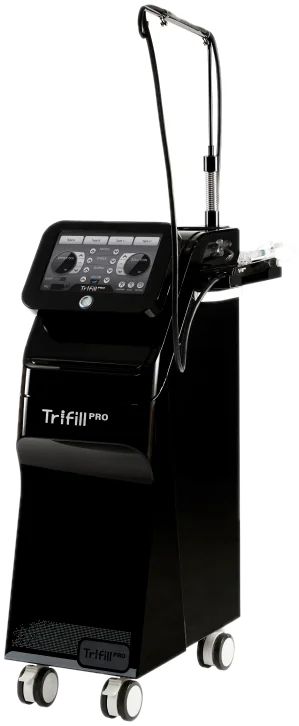
Subcision is a structural treatment for depressed scars. ABLE Dermatology uses TriFill air-based subcision, a breakthrough technology that severs fibrous bands using pressurized air instead of a needle. This approach is more precise, more uniform, and safer than traditional needle subcision. Crucially, filler is simultaneously injected to elevate the scar and restore volume immediately, providing visible improvement from the first session.
At ABLE Dermatology, a board-certified dermatologist makes the diagnosis in person, and every step is performed under ultrasound guidance.
Not all acne scars are equal. Depressed (atrophic) scars come in distinct morphologies, each requiring tailored treatment. Boxcar scars are broad, angular indentations with well-defined edges—typically 1.5-4 mm wide. They form when inflammation destroys dermis over a wide area. Rolling scars are wavy, undulating depressions that give the skin a rippled texture; they form when broad areas of tissue are pulled downward. Ice-pick scars are deep, narrow punctate depressions resembling a needle poke—the most structurally challenging to treat. Underlying all of these is the same pathophysiology: fibrotic bands anchoring the epidermis downward. Subcision breaks these anchors; laser and microneedling smooth the resulting contour.
Traditional needle subcision uses a sharp blade inserted beneath the scar to blindly cut fibrotic tissue. This approach is unpredictable: depth and pressure vary with each stroke, leading to inconsistent results and higher risk of bleeding and bruising. TriFill technology replaces the needle with a precisely controlled jet of pressurized air. This jet creates a defined cavitation zone that uniformly severs fibrous bands at the exact treatment depth. Because force is distributed evenly rather than concentrated in a point, surrounding healthy tissue is spared. Simultaneously, hyaluronic acid filler (Synergist) is injected into the released space, instantly lifting the scar and restoring volume. The entire process is guided by ultrasound imaging, ensuring accuracy. Recovery is faster and gentler than needle-based approaches.
Many patients ask: "Should I get laser instead?" The answer is that subcision and laser treat different problems and work synergistically. Laser and microneedling stimulate collagen remodeling and improve surface texture and dyspigmentation, but they do not mechanically break fibrotic tethers. A laser cannot lift a scar that is still anchored by underlying tissue bands. Conversely, subcision breaks tethers but does not directly address surface irregularities or color mismatch. The optimal approach for moderate-to-severe depressed scars is subcision first (to elevate and release), followed by laser or microneedling 4-6 weeks later (to refine contour and color). This two-stage strategy delivers superior results compared to either treatment alone.
Deep scars that are visibly anchored downward. Subcision is specifically designed to break these fibrous tethers and allow the skin to rebound. Most dramatic improvement is seen in patients with clear mechanical tethering.
Broad, angular or wavy depressions that affect large facial areas. These scars respond exceptionally well to subcision because the underlying pathology is widespread fibrotic anchorage. Boxcar scars in particular show 50-70% improvement after a series of subcision sessions.
Deep, narrow scars and mixed morphologies benefit from combined treatment. While ice-pick scars are most challenging, subcision significantly improves even these, especially when paired with filler and subsequent laser refinement.
Evidence-based, patient-centered care
Our dermatologist performs a detailed morphological analysis of your scars. We identify scar type (boxcar, rolling, ice-pick), depth, width, and the extent of underlying fibrotic tethering. English-language consultation is standard. We explain what can be realistically achieved and develop a personalized multi-session treatment plan.
Ultrasound guidance ensures the air-based subcision jet targets the exact depth of fibrotic tissue. Filler is injected simultaneously to lift the scar. The procedure takes 30-60 minutes depending on scar extent. Most patients see 30-50% improvement after the first session, with progressive improvement over subsequent treatments.
If desired, fractional CO2 laser or radiofrequency microneedling is performed 4-6 weeks after subcision to address remaining surface irregularities and dyspigmentation. This two-stage approach optimizes both structural and cosmetic outcomes.
Minimally invasive, structured, step-by-step
The face is thoroughly cleansed with an antiseptic. A local anesthetic is applied topically and injected around the scar areas to ensure complete comfort during treatment. We typically allow 10-15 minutes for anesthesia to take effect.
Using real-time ultrasound imaging, the dermatologist positions the TriFill handpiece perpendicular to the skin. Pressurized air severs fibrotic bands at the predetermined depth. The procedure is systematic, ensuring uniform treatment across all affected areas. You will feel pressure and vibration but no cutting or pain.
Immediately after subcision, hyaluronic acid filler (Synergist) is injected into the released subcutaneous space. This elevates the scar and restores volume, providing immediate visible improvement. A soothing serum is applied. No bandages are required. Makeup can be worn immediately if desired.
Immediate improvement is visible on the day of treatment due to filler elevation and reduced tethering. However, the most dramatic improvement emerges over 2-4 weeks as inflammation resolves and collagen reorganization begins. Most patients achieve 30-50% improvement per session. Boxcar scars typically require 3-5 sessions spaced 4-6 weeks apart. Rolling scars may need 3-4 sessions. Ice-pick scars are most challenging and may require 5+ sessions for a good outcome. Some scars improve by 70-90% with this regimen; others improve by 40-50%. Results depend on baseline scar severity, skin type, age, and healing capacity. Our dermatologist will discuss realistic expectations for your specific scars during consultation.
The injected filler gradually absorbs over 12-18 months. Whether further sessions are needed is decided at follow-up.
Precision begins with comprehensive diagnosis
We comprehensively evaluate scar morphology, depth, tether patterns, and surrounding skin condition. Precise assessment determines the optimal number of sessions, technique selection (air subcision vs. needle), and whether combination treatments (filler, lasers) are indicated. Your goals and realistic outcomes are discussed in detail.
Using TriFill air-based subcision technology, our board-certified dermatologist severs fibrous tissue bands with pressurized air, which is more uniform and precise than needle-based techniques. Simultaneous filler injection elevates released scars and restores volume. Ultrasound guidance ensures anatomical accuracy and safety.
We provide detailed aftercare instructions to optimize healing and results. Cool compresses minimize swelling; activity modifications prevent complications. Follow-up assessment at 4 weeks determines if additional sessions are needed. Our dermatologist monitors your progress and adjusts future treatment plans based on scar response and your objectives.
Yes. Subcision addresses the structural cause of depressed scars, while laser and microneedling treatments refine surface texture and color. Many patients see further improvement by combining subcision with fractional CO2 laser or radiofrequency microneedling 2-4 weeks after subcision. Your dermatologist will recommend the optimal combination for your scars.
The number of sessions depends on scar depth and extent. Most patients benefit from 3-5 sessions spaced 4-6 weeks apart. Your dermatologist will assess scar morphology during your consultation and create a personalized treatment plan tailored to your specific scar types and severity.
Subcision has minimal downtime. Most patients resume normal activities immediately. Mild swelling may last 24-48 hours. We recommend cool compresses for the first 48 hours and avoiding extreme heat (saunas, steam rooms, intense exercise) for one week. Makeup can be applied immediately if desired.
Subcision severs the fibrous tissue bands beneath depressed acne scars. Deep, tethered scars form when scar tissue pulls the skin downward. Breaking these fibers releases the tether, allowing the scar to rise and improve in appearance. ABLE Dermatology uses TriFill air-based subcision, which uses high-pressure air instead of a needle for more precise treatment.
Absolutely. If you have a flight soon after treatment, let us know your schedule at the consultation and we will advise you. We provide English consultation, detailed aftercare instructions in writing, and can arrange follow-up via photo consultation if a second session is needed. Airport Bus 6300 arrives just 90 minutes from Incheon Airport, so travel is convenient.
Most patients see 30-50% improvement in scar appearance after one session. Boxcar and rolling scars often improve more dramatically (50-70%) than ice-pick scars (20-40%). Improvement continues for 2-4 weeks as inflammation resolves. Peak results appear at 4-6 weeks. Multiple sessions yield progressive cumulative improvement; most patients benefit from 3-5 sessions for a good outcome.
Let us know your flight schedule at the consultation and we will advise you. Mild swelling may persist, but it resolves within 7-10 days. Continue avoiding saunas and extreme heat for 48 hours post-treatment.
ABLE Dermatology accepts major international credit cards (Visa, Mastercard, American Express), Korean debit cards, and Korean Won cash. We can provide detailed invoices for international insurance claims if applicable. Foreign currency exchange is available on-site for convenience.
Be able to choose, not be pushed.
This page is for informational purposes only. Individual results may vary. Please consult with our dermatologist for personalized treatment recommendations.