

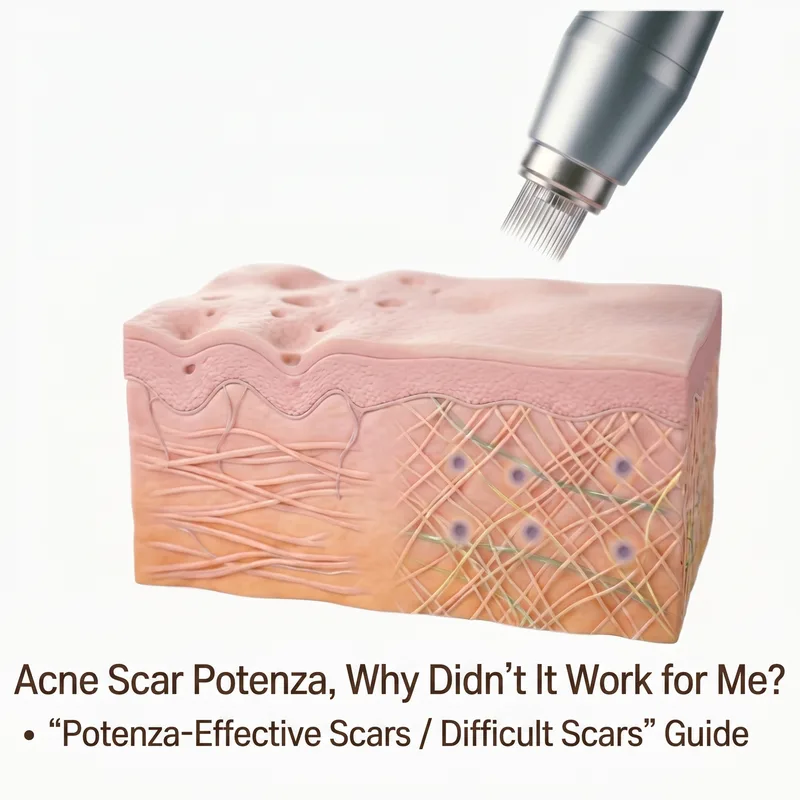
Why Does Potenza Work for Some People But Not Others?
Potenza RF microneedling is now widely known for acne scar treatment, yet satisfaction varies dramatically among patients. Some experience remarkable improvement while others report "no effect" despite multiple sessions. This variation is not a treatment failure—it reflects the critical match between scar characteristics and Potenza's specific strengths.
Understanding when Potenza works requires understanding what it actually does and which scar types respond best.
How Potenza RF Microneedling Works
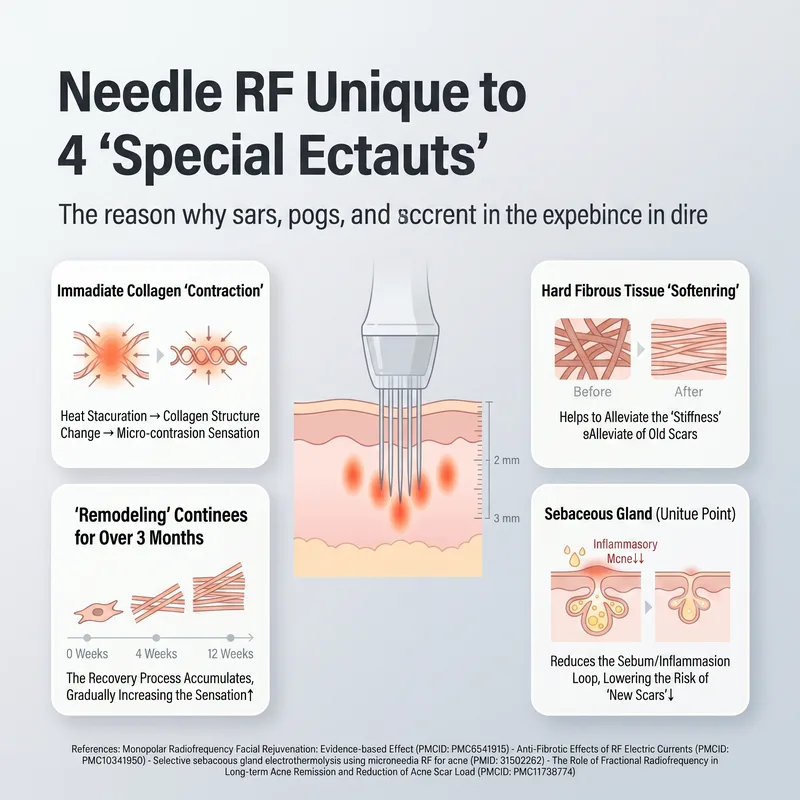
Potenza operates through three distinct stages:
Stage One: Microchannels Formation
Fine needles create small channels deep within the dermis without extensively damaging the epidermis. Unlike lasers that ablate the entire epidermis, this creates relatively short downtime.
Stage Two: Radiofrequency Heat Energy
60-70°C RF energy creates zones of controlled thermal coagulation around these channels. This generates biological effects completely different from simple mechanical injury.
Stage Three: Collagen Restructuring
During healing, dermal collagen and elastic fibers gradually realign. Critically, this is not a one-time event—results accumulate through repeated healing cycles.
Scar Types Where Potenza Excels
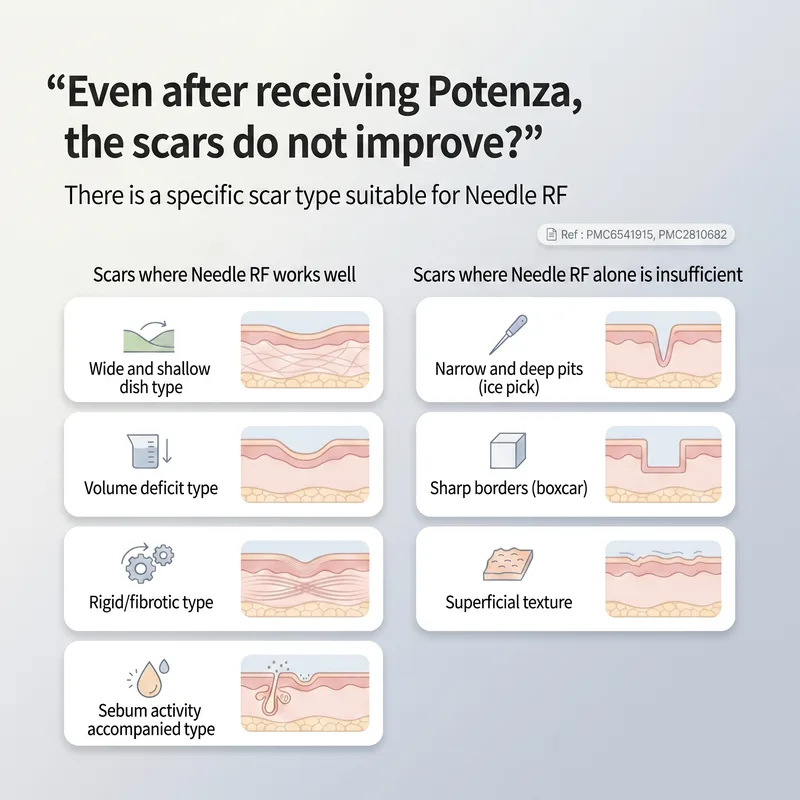
Potenza's actual strength is not "reducing scar depth" but "making indentations less visible by blending boundaries and improving texture". Understanding this clarifies when to choose Potenza.
Potenza is highly effective for:
Rolling scars with pore enlargement - Shallow but uneven surface with enlarged pores. Potenza excellently refines surface texture and pore appearance.
Shallow boxcar scars - Clear borders but moderate depth. Potenza softens boundaries and blends scar margins naturally with surrounding skin.
Scars with accompanying skin texture loss - When overall skin quality matters more than individual scar depth. Potenza simultaneously improves general skin quality.
Scar Types Where Potenza Has Limitations
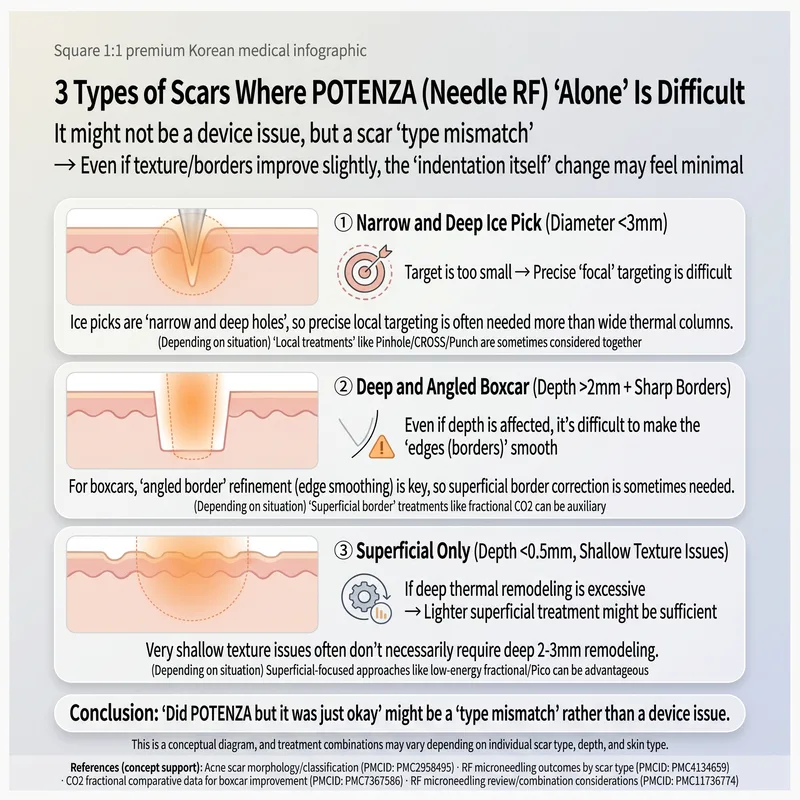
Knowing where Potenza falls short is equally important:
Deep boxcar or ice-pick scars - Deep, sharply defined margins. Potenza alone cannot adequately fill these depths. Subcision, CO2 laser, or filler combinations work better.
Very deep rolling scars - Potenza alone cannot sufficiently release the underlying adhesions. Combining subcision (to release attachments) with subsequent Potenza provides synergy.
Keloid-type scars - Raised rather than depressed scars require entirely different approaches.
Critical Point: Same Device, Different Settings
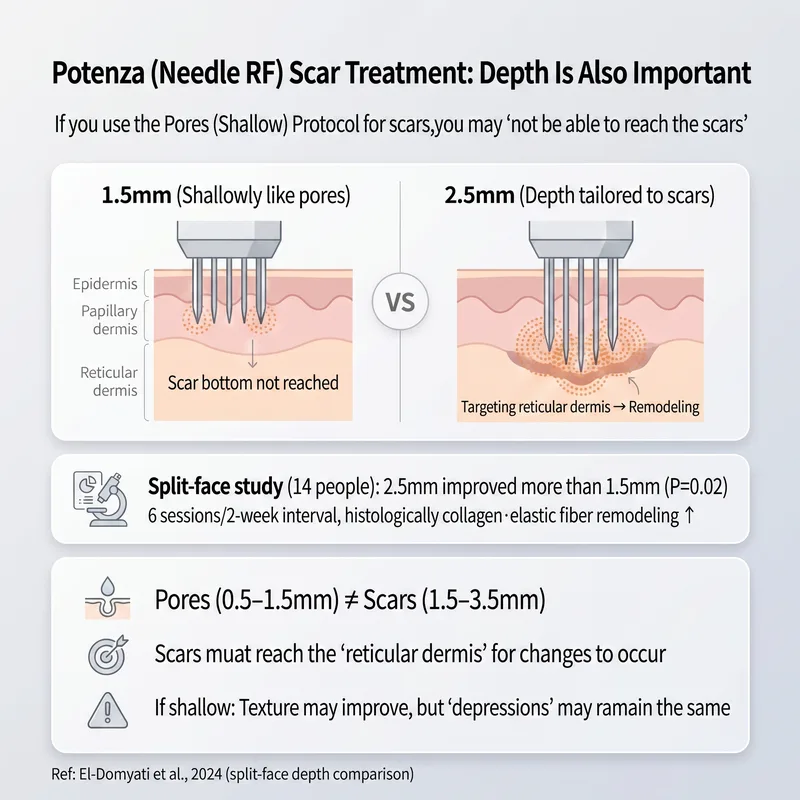
An often-overlooked detail: "Potenza is the same machine, but settings completely change treatment effects".
Potenza for pores and Potenza for scars use completely different depths, energy intensities, and protocols. Pore treatment targets superficial layers quickly, while scar treatment penetrates deeper and emphasizes cumulative results. The same device produces entirely different outcomes depending on how it's programmed.
During consultation, ask specifically: "Is Potenza appropriate for my scar type? If yes, what depth settings and how many sessions?" rather than simply "I want Potenza treatment."
Maximizing Potenza Results
Accumulation is key. Potenza is not a "one-time perfect outcome" treatment. Most patients notice meaningful improvement only after 3+ sessions. Deeper or more established scars require additional sessions.
Combination treatments. Deep scars benefit from Potenza combined with subcision, CO2 laser, or fillers. For example, ice-pick scars can be partially filled with filler first, then Potenza refines the blended boundary—more natural than Potenza alone.
Adequate recovery intervals. Allow 4-6 weeks between Potenza sessions for proper healing and collagen remodeling.
The Importance of Correct Expectations
Potenza satisfaction ultimately depends on "aligning expectations with reality". Starting with "we can't reduce scar depth to zero, but we can soften boundaries and improve overall texture" sets realistic expectations that lead to higher satisfaction.
If your scar type doesn't match Potenza's strengths, alternative or combination treatments recommended from the start are far wiser than applying Potenza to unsuitable scars. Potenza is excellent—but not universally optimal.
Frequently Asked Questions
- Why does Potenza RF microneedling seem ineffective for acne scars?
- Potenza excels at dermal remodeling but has limitations as a standalone treatment for deep scars like ice pick types. Proper energy settings matched to scar type and combined treatment strategies are essential.
- Which scar types respond best to Potenza?
- Rolling scars and shallow boxcar scars respond best. Potenza stimulates dermal collagen to smooth the skin surface. For deeper scars, combining with subcision maximizes results.
Want to determine the right treatment for your scars?
Explore Scar Treatment Options Schedule Consultation