

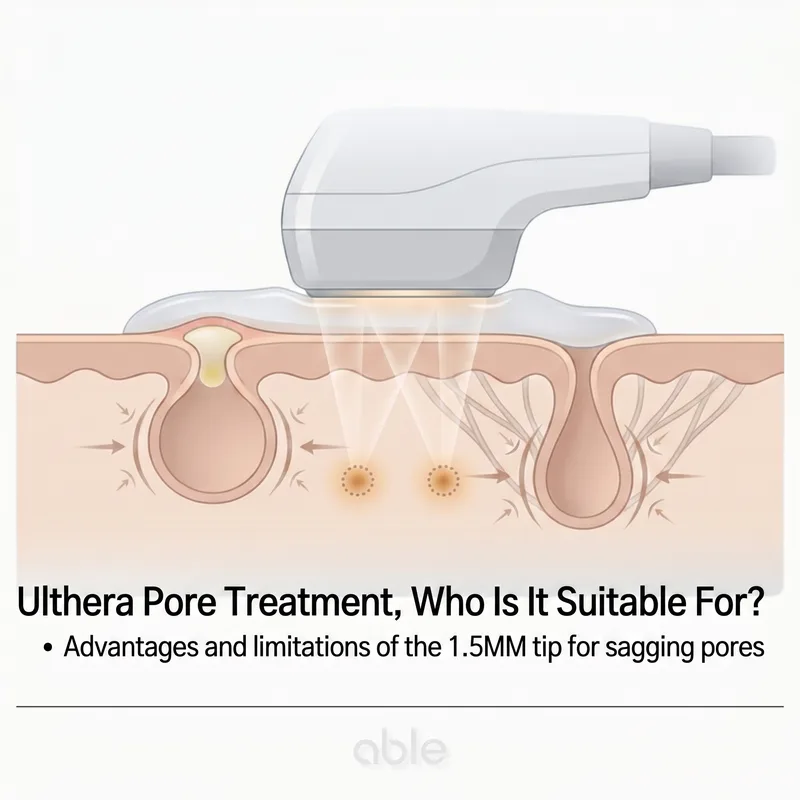
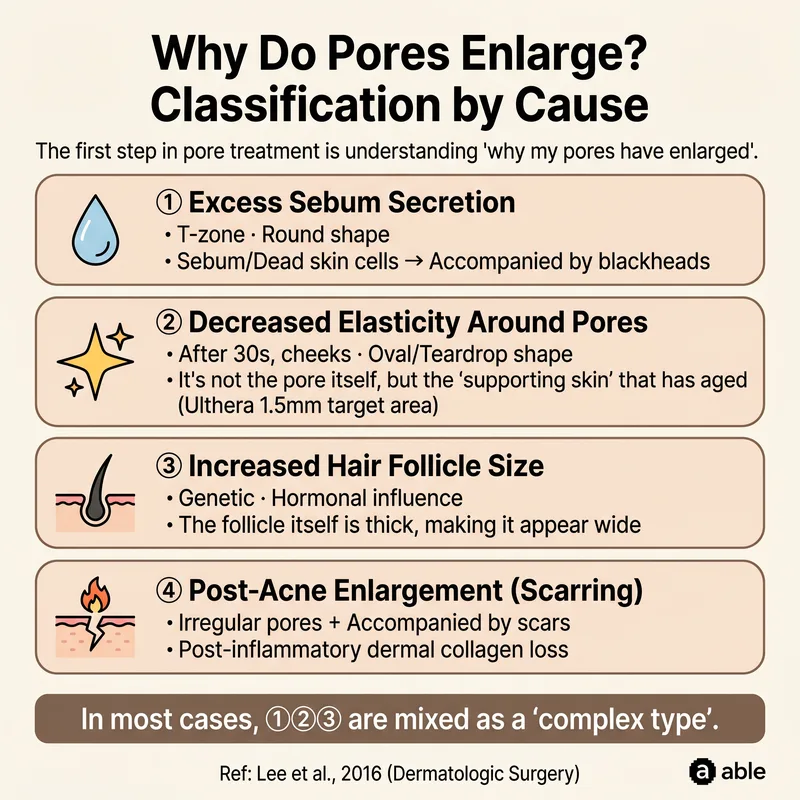
Pore Enlargement Has Multiple Causes
Effective pore treatment begins with understanding the root cause: "Why are my pores enlarged?" Medical research identifies three distinct mechanisms. First, excessive sebum production physically widens pore openings. These round pores typically appear in the T-zone and affect younger age groups. Second, loss of skin elasticity around the pore causes enlargement. Common in patients over 30, these elongated or tear-drop shaped pores develop on the cheeks. Third, inherently large follicle size due to genetic and hormonal factors. Most patients experience a combination of these causes rather than just one.
Therefore, accurate diagnosis of the primary causative factor before treatment begins is essential for planning an effective strategy.
Ultherapy's Multi-Depth Approach and the 1.5mm Tip
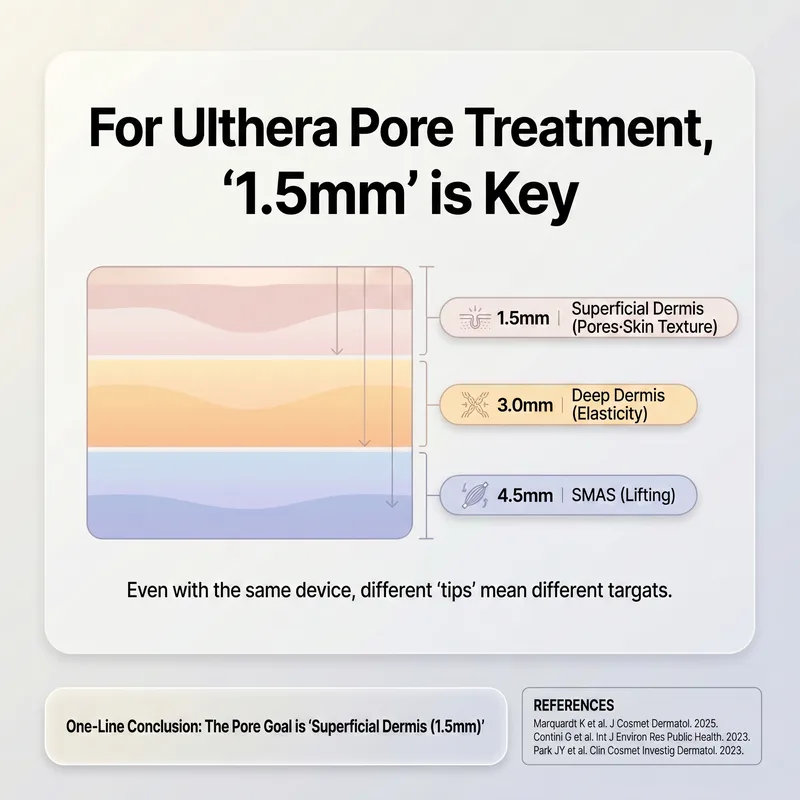
Ultherapy is far more than a simple lifting device. Its multiple tips operating at different depths create layered treatment effects. The 4.5mm tip targets the fascia for structural facial lifting. The 3.0mm tip stimulates deep dermal collagen to increase skin thickness and density. The 1.5mm tip concentrates on the superficial dermis specifically for pore and skin texture refinement.
The collagen and elastin structures forming pore walls sit in an extremely shallow layer directly beneath the skin surface. The 1.5mm tip delivers ultrasound energy precisely at this depth, creating controlled thermal coagulation zones. This process stimulates new collagen and elastin production, thickening pore walls while naturally tightening enlarged pore openings.
Advantages and Limitations of 1.5mm Ultherapy
Ultherapy's greatest advantage is its long treatment interval. Single treatments can maintain results for 12-18 months, making it ideal for busy patients. Pain is minimal, requiring only topical anesthesia, and there is virtually no downtime, allowing immediate return to normal activities.
However, standalone efficacy is limited. Clinical research shows Ultherapy 1.5mm alone achieves approximately 25% pore reduction. While meaningful, this may be insufficient for many patients. Results develop slowly, requiring 1-2 months for visible changes. Additionally, the 1.5mm tip is relatively weak against sebaceous pores, making combination with sebum-suppressing treatments like skin booster procedures 2.5 times more effective.
Treatment Strategy Based on Pore Type
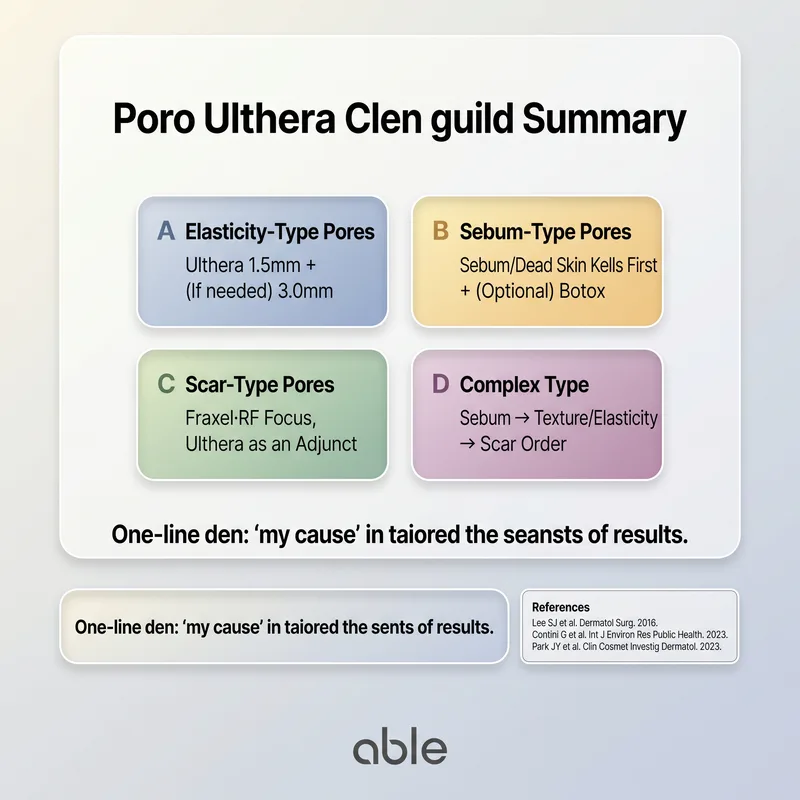
For sebaceous pores with excessive oil production, the primary treatment priority is reducing sebum. Skin boosters, sebum-suppressing skincare, or oral medications serve as first-line therapy, with Ultherapy playing a supporting role.
For elasticity-loss pores, the 1.5mm tip becomes the primary treatment. However, when severe elasticity loss and sagging coexist, full-face Ultherapy using 1.5mm, 3.0mm, and 4.5mm tips together proves more effective.
For genetically large follicles, direct follicle size reduction is impossible. However, strengthening surrounding skin structure creates a relative improvement in appearance.
Ultherapy vs. Alternative Pore Treatments
Competing technologies each have distinct advantages. Potenza delivers faster results (2-4 weeks) but causes greater pain and requires 3-5 days downtime. Picofractional also shows rapid improvement but demands 4-7 days recovery.
While Ultherapy may produce weaker standalone results, its minimal discomfort and downtime make it an excellent choice for working professionals or those seeking recovery-free treatment.
Key Considerations When Planning Pore Treatment
Ultherapy 1.5mm is particularly suited to patients with elasticity-loss pores, those wanting to avoid downtime, and those seeking overall skin texture improvement alongside pore refinement. Conversely, patients desiring rapid visible changes, those with prominent T-zone sebaceous pores, or those with significant facial sagging may benefit more from alternative or combination approaches.
Frequently Asked Questions
- Does Ultherapy work for enlarged pores?
- Yes, for elasticity-related pore enlargement. The Ultherapy 1.5mm tip targets the upper dermis to induce collagen contraction and regeneration, strengthening the support structure around pores to make them appear smaller.
- How does Ultherapy for pores differ from lifting treatment?
- Lifting uses deep 3.0mm and 4.5mm cartridges targeting the SMAS layer, while pore treatment uses the shallow 1.5mm cartridge focused on the dermis. Energy settings and shot density differ significantly.