

ABLE Dermatology does not perform thread lifting. The comparison below sets out which layer each lifting approach acts on.
Lifting vs. Tightening — Clarifying the Terminology
When researching skin sagging treatments, you'll often encounter the terms "lifting" and "tightening." While these terms are sometimes used interchangeably, they have distinct meanings in aesthetic medicine.
Tightening refers to contracting collagen in the superficial dermis and skin surface, making the skin appear more taut. This is primarily achieved through heat energy that causes collagen network reorganization. The skin essentially becomes smaller rather than the drooping tissue being physically lifted.
Lifting targets deeper layers, particularly the SMAS (Superficial Musculo-Aponeurotic System), to physically pull sagging tissue upward. Rather than just shrinking the skin, it reorients facial structure, resulting in more dramatic lifting effects.
RF Lifting (Thermage) — Principles and Applications
Radiofrequency (RF) lifting, exemplified by Thermage, uses RF energy to vibrate water molecules in tissue, generating approximately 60°C of heat. This heat contracts dermal collagen, creating immediate tautness while stimulating new collagen formation.
How Thermage Works
- Epidermal Protection: A specialized cooling system shields the epidermis while selectively heating the dermis.
- Broad Treatment Area: Large handpieces treat extensive areas efficiently in minimal time.
- Immediate Results: Patients often notice skin tightness immediately after treatment.
- Progressive Improvement: Over 2-3 months, collagen remodeling enhances results further.
When Thermage is Most Effective
Thermage delivers good outcomes for early-stage sagging with adequate skin thickness and remaining elasticity. Results become limited in thin skin or significant fat loss scenarios.
| Condition | How well RF fits | Planning note |
|---|---|---|
| Normal thickness + mild sagging | Fits well | Density Alpha across the dermis |
| Thin skin + mild sagging | Only with output control | Lower output, different tip |
| Normal thickness + moderate sagging | Not enough alone | Split layers with Ultherapy (HIFU) |
| Clear volume loss | Energy alone is limited | Consider collagen boosters |
Ultrasound Lifting (Ultherapy) — Understanding SMAS Targeting
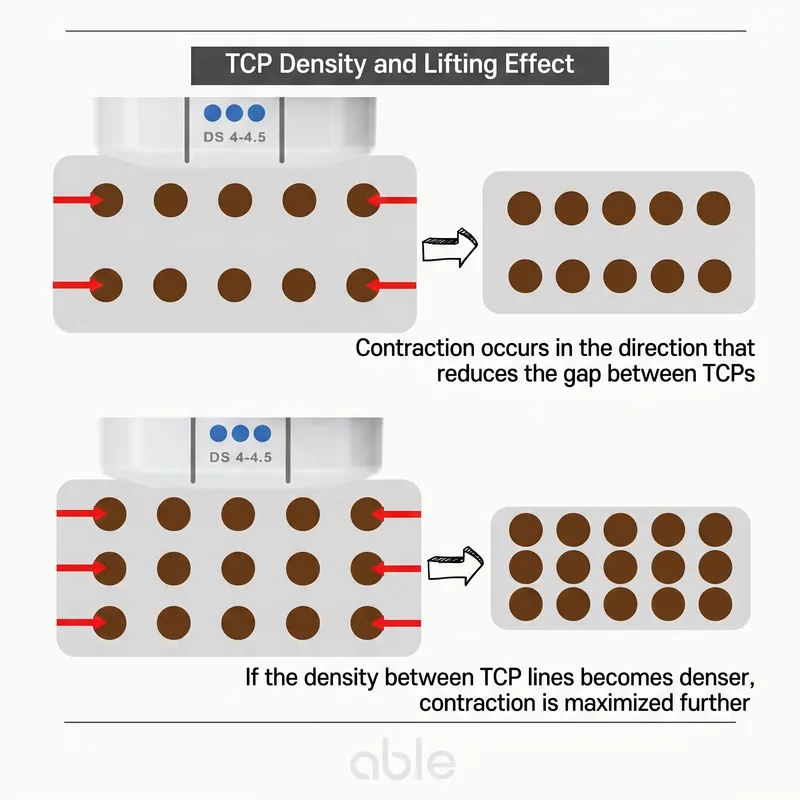
Ultherapy utilizes Micro-Focused Ultrasound with Visualization (MFU-V), which concentrates ultrasound energy at precise depths, delivering high-energy ultrasound distinctly different from standard ultrasound therapy.
Ultherapy's Innovation — Visualization Technology
Ultherapy's greatest advancement is real-time visualization. During treatment, ultrasound imaging confirms target tissue identification while energy delivery occurs. This enables precise SMAS thermal energy concentration.
Ultherapy's Depth-Specific Effects
- 1.5mm (Epidermal-Dermal Junction): Skin texture improvement, fine line softening. Immediate collagen contraction.
- 3.0mm (Mid-Dermal Layer): Skin elasticity improvement, moderate wrinkle reduction. Dermal collagen reorganization.
- 4.5mm (SMAS Fascial Layer): Fundamental facial lift. Most dramatic lifting effect. Progressive post-treatment improvement.
Ultherapy's Unique Characteristic
Progressive post-treatment improvement distinguishes Ultherapy. Initial thermal collagen contraction followed by 6-month neo-collagen formation drives structural improvement. What sets it apart is that the energy is delivered to the SMAS — the supporting layer — rather than to the skin surface.
Severe SMAS sagging (marionette lines, cheek descent, undefined jawline) particularly demonstrates Ultherapy's superiority.
Thread Lifting — Physical Elevation Benefits and Limitations
Thread lifting inserts biodegradable or semi-permanent sutures between skin and fascia to physically elevate sagging tissue.
Thread Lifting Advantages
- Immediate Results: Elevation occurs during suture placement without waiting.
- Minimal Tissue Damage: No thermal injury compared to energy-based treatments.
- Precise Adjustability: Practitioners can fine-tune elevation degree during procedure.
- Tissue Stimulation: Insertion triggers inflammatory response promoting neo-collagen formation.
Thread Lifting Limitations
- Time Constraints: Biodegradable sutures dissolve within 6-12 months requiring periodic retreatment.
- Unpredictability: Suture migration or self-loosening reduces outcome consistency.
- Complication Potential: Asymmetric elevation, suture extrusion, infection, nerve damage are rare possibilities.
- Technique Dependency: Outcomes significantly depend on practitioner experience and skill.
When Thread Lifting is Appropriate
Ideal for those seeking immediate elevation or uncomfortable with energy-based treatments. Also effective as supplementary treatment following other procedures requiring additional improvement.
Selecting Based on Skin Thickness and Fat Distribution
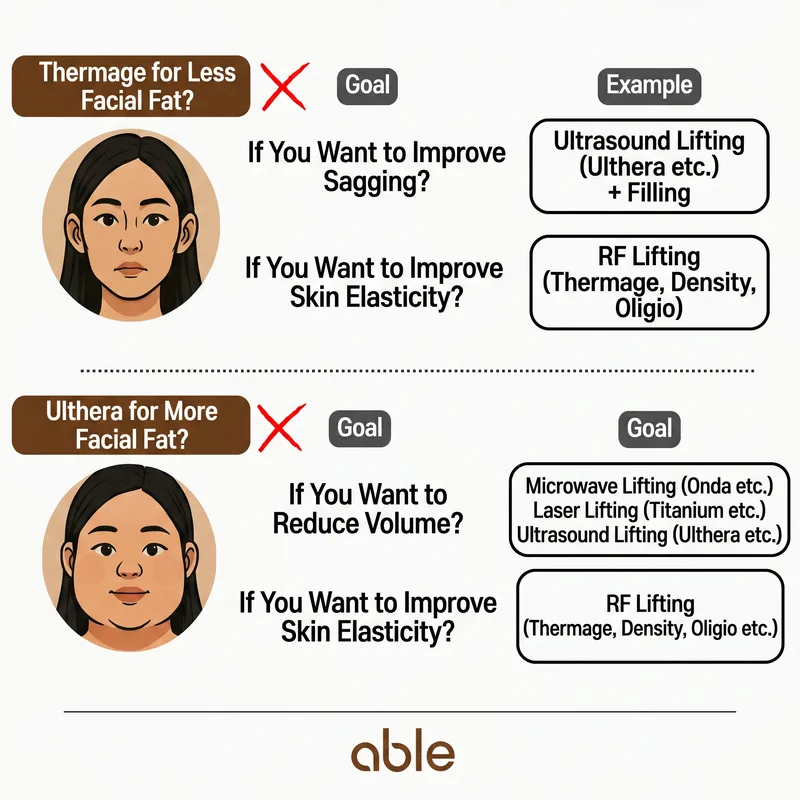
Lifting success significantly depends on patient anatomy. Identical procedures yield different outcomes based on baseline skin conditions.
Adequate Skin Thickness Cases
Recommendation: Ultherapy or Density Alpha (High-Power RF)
Thicker skin conducts heat energy effectively, with stronger collagen regeneration response. Energy-based procedures yield good outcomes. Density Alpha (mono + bipolar sequential RF) safely delivers higher energy as skin thickness increases, maximizing tightening effects.
Thin Skin Cases
Recommendation: Ultherapy (Low-Energy SMAS-Targeted) or Olewave (Collagen Stimulation)
Thin skin presents heat sensitivity, with burn or excessive inflammation risk. Ultherapy is safer with energy modulation or deep SMAS-only (4.5mm) targeting. Olewave (piezo ESWT) stimulates collagen without thermal injury, remaining safe regardless of skin thickness.
Significant Fat Distribution Cases
Recommendation: Ultherapy (SMAS-Targeted)
Abundant fat makes skin-only tightening inadequate. Fundamental lifting addressing SMAS directly becomes essential, where Ultherapy's deep targeting excels. When the fat layer also needs to be addressed, Onda (2.45GHz microwave) may be combined in the plan.
Minimal Fat Cases (Elderly Patients)
Recommendation: ABLE Signature Wave Ulthera (Ulthera + Olewave sandwich) + Collagen Booster Combination
Minimal fat limits how much energy-based treatment alone can achieve, because contracting the skin does not restore lost volume. The approach here pairs Wave Ulthera for laxity with collagen boosters for volume. Where volume loss is extensive a surgical approach may be required, and ABLE Dermatology does not perform those operations.
| Patient type | First choice | Also consider | Note |
|---|---|---|---|
| Thick skin + mild sagging | Density Alpha (sequential RF) | Ultherapy | Heat transfers well |
| Thin skin + mild sagging | Ultherapy (4.5mm) | Olewave | Planned at lower output |
| Normal skin + significant fat | Onda (2.45 GHz microwave) | Ultherapy | Reduce fat first, then tighten |
| Thin skin + volume loss | Collagen boosters | Ultherapy | Energy cannot create missing volume |
Combination Treatment Strategies — Beyond Single Modality
Facial sagging involves multiple layers. Epidermis exhibits wrinkles, dermis shows elasticity loss, fascia shows sagging, and fat repositions simultaneously. Single-modality treatment rarely achieves good outcomes.
The Combinations We Actually Use
1. Ultherapy + Density — two energies, two layers
Ultherapy reaches the SMAS with focused ultrasound; Density works the dermis with 6.78 MHz radiofrequency. The target layers do not overlap, so neither takes the other's place. When deep descent and surface laxity are both present, we split the work between them.
2. Wave Ulthera — Olewave + Ultherapy
Piezoelectric shockwave (Olewave) loosens the tissue first, Ultherapy follows, and shockwave finishes — a sandwich sequence. Shockwave alone does not lift much, and HIFU alone is less comfortable, so the order is split.
3. Onda + Ultherapy — fat-driven sagging
When submental fat is the main driver, 2.45 GHz microwave (Onda) reduces the deep fat first and Ultherapy then takes up the remaining skin. Reversing the order leaves skin where the fat used to be.
4. Ultherapy + collagen boosters — sagging with volume loss
Energy devices tighten the tissue that is there; they do not create volume that is gone. If the anterior cheek or temple is hollow, we choose among Sculptra (PLLA), Juvelook Volume (PDLLA), Radiesse (CaHA) and GOURI (liquid PCL) by layer and purpose.
Essential Verification Before Treatment Selection
1. Provider Experience and Credentials
Dermatologists should perform lifting treatments safely. Visualization-dependent treatments like Ultherapy particularly benefit from board-certified practitioners. Verify practitioner principle understanding and complication management experience.
2. Equipment Authenticity
Counterfeit products and outdated machines are prevalent. With RF devices the model and generation change how tips and output are set, so ask which one is in use. Confirm Ultherapy manufacturing dates. Practitioners should articulate equipment specifications clearly.
3. Realistic Expectation Setting
All treatments have limitations. Claims of "surgical-level outcomes guaranteed" signal concern. Quality practitioners clearly explain what is achievable and what exceeds treatment capabilities.
4. Complications and Recovery
- RF devices: Immediate normal activities. Extremely rare surface burns.
- Ultherapy: Minor swelling, discomfort 1-2 weeks. Rare nerve irritation.
- Thread Lifting: 2-3 day swelling and pulling sensation. Rare asymmetric lifting.
5. Post-Treatment Care Importance
Treatment efficacy depends substantially on post-care. UV protection, hydration, protein intake, and avoiding aggressive manipulation matter significantly. Ultherapy specifically benefits from 3-month lifestyle optimization affecting results.
Frequently Asked Questions
Consult with our specialist about the ideal lifting procedure for your unique skin condition.
Sagging Treatment Consultation Book Specialist Consultation