

Medically reviewed by Dr. Jeong Kyungmuk, board-certified dermatologist · Last updated
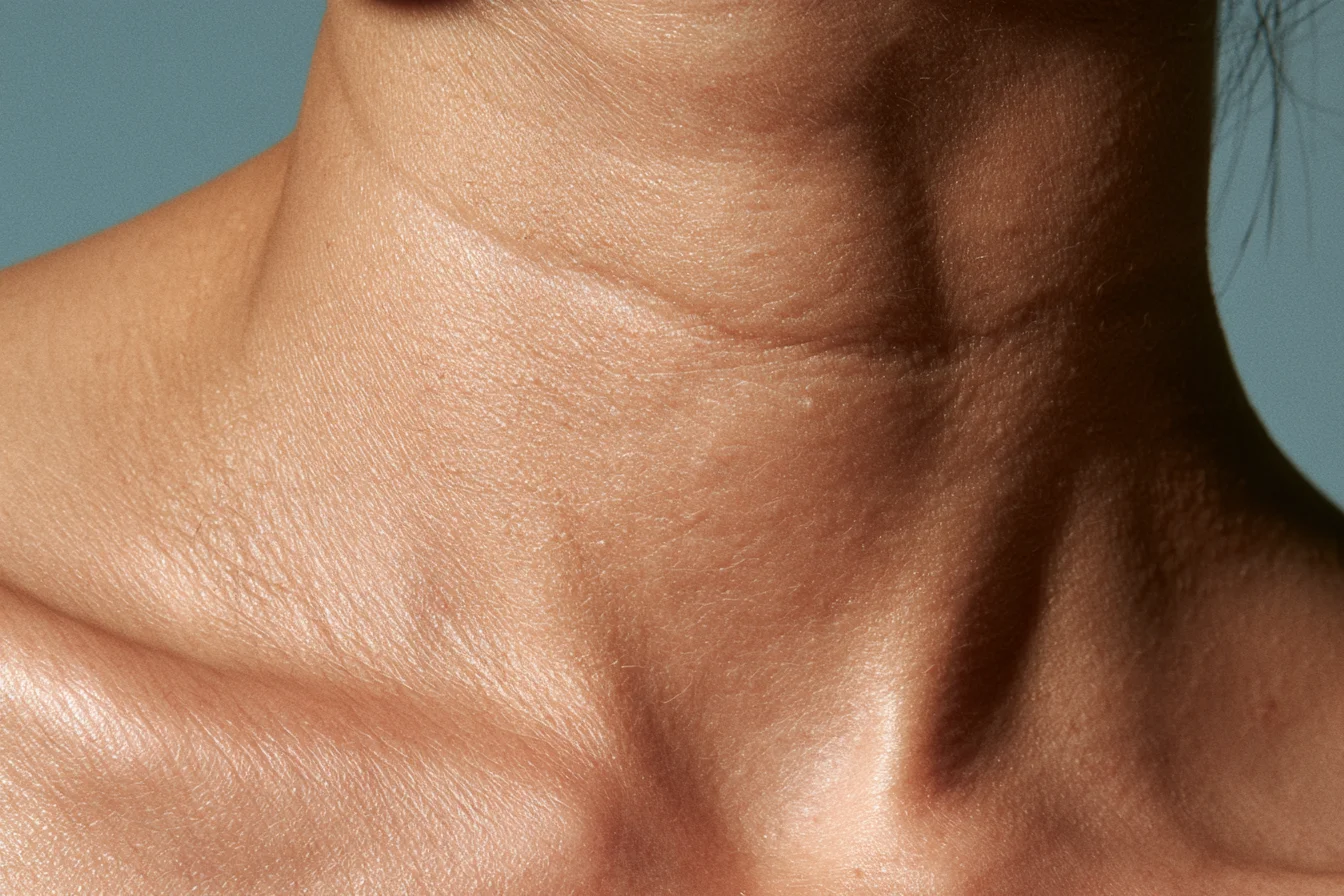
Neck wrinkles are usually blamed on thin neck skin or on looking down too often. So the fixes people picture are a neck cream, or a single procedure that smooths everything at once. Yet when we look closely at necks in the clinic, one person often has a mix of things: lines folded across the neck, bands that stand up vertically, fine crepey wrinkling, and skin that has drooped. Do all four really come from the same cause? "Thin neck skin" is only half the story. Ultrasound studies have measured neck skin thicker than several areas of the face, and research suggests vertical bands appear because the muscle moves, not because it has gone slack. We see neck wrinkles as different shapes made by different parts: the skin itself (the dermis), the fibrous connections that tie skin to muscle, and the movement of a thin muscle called the platysma. This column sorts the shapes first, then follows the research on which treatment suits each.
Three-Line Summary
- Neck changes can be sorted into four shapes: horizontal lines, vertical bands, crepey skin and laxity, and in research these changes began at different ages.
- Neck skin is not necessarily thinner than facial skin. It is closer to say that elasticity — the quality and arrangement of collagen and elastic fibres — gives way before thickness does. Add accumulated UV, and crepey lines and blotches tend to come together.
- Horizontal lines are explained by fibrous connections that hold the skin down beneath each crease, and vertical bands by the platysma moving. So horizontal lines suit lifting the crease from below with a thin filler, vertical bands suit Botox that reduces movement, and laxity calls for firming the dermis and fibrous septa — each considered separately.
The Four Shapes of Neck Wrinkles — Lines, Bands, Crepey Skin and Laxity Are Not One Problem
Changes in the neck can be sorted into four broad shapes.
- Horizontal lines — one or two grooves running around the neck
- Vertical bands — cords that stand up from under the jaw toward the collarbone when you clench your teeth
- Crepey skin — a wide, finely crinkled texture like crumpled thin paper
- Laxity — excess skin that sags and blurs the line under the jaw
One study looked at whether these four really behave separately. In Xie et al. (2018; 450 Chinese women aged 16–66), changes such as horizontal lines, sagging and vertical bands began to appear at different ages — the same neck, but each sign had a different starting point. Once they appeared, all of them worsened gradually with age, and skin elasticity was reported to start declining before most of the changes became visible.
It was a cross-sectional study that captured several age groups at one time rather than following the same people for years, and it included only Chinese women, which should be kept in mind. Still, different starting points suggest the causes may differ too.
A Twist on Neck Skin Thickness — Studies Where the Neck Dermis Was Not Thinner Than the Face
"The neck has thinner skin than the face" is an explanation Dr. Jeong also used in an earlier basic post on neck wrinkles on his blog, and it is a point that now needs correcting.
In an ultrasound study by Meng et al. (2022; 118 adults — 49 men, 69 women), epidermal and dermal thickness was measured at seven facial sites and on the neck. In women, the neck dermis averaged 0.99 mm, measuring thicker than the forehead (0.86 mm), cheekbone (0.87 mm) and eyelid (0.58 mm) — the thickest value among the eight sites in women. The male neck dermis was 0.98 mm, and while men were thicker at most sites, the neck dermis showed no meaningful difference between men and women.
The age pattern is interesting too. In women, the cheekbone and submental dermis grew thinner with age, but the neck dermis measured 0.96 mm at 18–44, 1.02 mm at 45–59 and 1.03 mm at 60 and over, with no meaningful difference between age groups. In other words, the neck dermis did not thin with age as much as one might expect. However, there were only five women aged 60 or over, so the data cannot be said to represent older women's necks, and ultrasound values are hard to set directly against thickness measured on tissue sections.
There are opposite results as well. In Kim et al. (2013; 58 Korean women aged 25–64), the neck dermis measured thinner than the cheek. Depending on the device and the site, the neck can come out thinner or thicker. But the same study had another notable finding: neck skin stretched more easily than cheek skin, and of all the sites measured, neck elasticity was the most strongly linked to age. Thickness varies from study to study, while elasticity in the neck falls steadily with age — which is why neck wrinkles are better understood through elasticity than thickness.
Neck Wrinkles and Dermal Elasticity — The Quality and Arrangement of Collagen and Elastic Fibres, More Than Thickness
The dermis holds up with two main kinds of fibre. Collagen bundles resist tearing when pulled, while elastic fibres (elastin) let the skin stretch and spring back. As age and UV accumulate, the collagen network is described as breaking into smaller fragments, so the skin's very ability to bear load declines (review by Rittié and Fisher, 2015). So even when thickness stays the same, if the fibres inside are broken and disordered, the skin folds and fails to spring back — like a rubber band that has lost its stretch.
There is also a study that examined tissue at horizontal neck lines directly. In Lee et al. (2017; 2 cadavers), many short, wavy elastic fibres were seen between the collagen of the dermis. Neck wrinkles are often said to form because elastic fibres "decrease", but at least in this tissue the difference was less about quantity and more about shape and arrangement — a hint that condition may matter more than amount.
Put together, what happens in the neck dermis is closer to "the quality and arrangement of the fibres change and the skin's recoil weakens" than to "the skin gets thinner".
Neck Wrinkles and Photoaging — Solar Elastosis, Poikiloderma of Civatte and the Oil Glands
The neck gets more sun than people think. Many apply sunscreen carefully to the face but skip the neck. In skin exposed to UV for a long time, damaged elastic material tangles and builds up in the upper dermis — a change called solar elastosis. The "material" of elastic fibres piles up, yet there is no recoil. The study above did not check whether the wavy elastic fibres it saw were solar elastosis, but it is a useful concept for understanding a neck that "has elastic fibres yet no elasticity".
The most visible sign of sun on the neck is poikiloderma of Civatte: the sides of the neck become blotchy in a reddish-brown net pattern, with fine vessels showing through and the skin looking thin. In Katoulis et al. (2005; 50 patients), this change appeared symmetrically on the sides of the neck and the upper chest and characteristically spared shaded areas such as under the chin — it forms only where sunlight reaches. It is not the same condition as neck wrinkles, but when crepey skin and redness or blotching appear together on the neck, we read it as a sign that photoaging is also involved. That is why bringing sunscreen down to the neck is basic.
Textbooks describe the neck as having less developed oil glands than the face, which is why the neck dries easily and needs more moisturising. Oil glands and hair follicles are also tied to healing: when a superficial wound heals, new skin grows up from cells around the follicles and oil glands. For this reason, lasers that remove the skin surface deeply are approached more cautiously on the neck than on the face.
The Anatomy of Horizontal Neck Lines — Fibrous Connections and Fat Beneath the Crease
Under the neck skin lies subcutaneous fat, and beneath that a thin sheet of muscle called the platysma. Within the fat, fine fibres run from the underside of the dermis toward the deeper layers, dividing the fat into compartments. These fibres are called retinacula cutis (fibrous septa); think of them as tethers that tie the skin to the structures below.
Research suggests these connections are built differently in the neck than in the face. In a cadaver tissue study by Sandulescu et al. (2020; 7 hemi-neck and 6 hemi-face specimens), the neck had parallel fibrous sheets on its shallow and deep sides, linked by vertical fibres between them. The researchers considered that the contracting force of the platysma is transmitted to the skin along this structure — an interpretation in which force travels differently from the face, where muscle bundles attach to the skin at points and fold it.
So what lies directly under a horizontal line? In the Lee et al. (2017; 2 cadavers) study above, sections through horizontal lines showed a ligament-like structure running up long from the platysma or the fascia beneath it toward the dermis. It was neither a typical ligament nor typical smooth muscle, and the researchers thought it might help explain why horizontal lines form — the possibility that something is holding down the base of the crease.
A quilted blanket makes this easy to picture: only where the stitches pull the outer fabric inward does a groove form, while the filling between them puffs up. Horizontal lines can be explained the same way — a groove forms where the connections beneath the skin hold it down. This explanation matters because of horizontal lines in younger people. In the Xie study, too, horizontal lines started at a different time from other changes, and some people in their 20s and 30s already have one or two distinct lines. Some horizontal lines are not well explained by ageing alone.
In people with fuller necks, the same connections may make the grooves look deeper between the bulging fat compartments, but no study has been identified that separately examined how body weight or neck fat thickness relates to the depth of horizontal lines. A word on smartphones as well: looking down keeps the usual creases folded for longer, so it can make existing lines more noticeable. However, no study has been identified that directly measured smartphone use time against neck wrinkles, so while posture is worth attending to, it is hard to say lines are "caused by smartphones".
Platysma Anatomy — Crossing Patterns That Differ From Person to Person
The platysma is a thin, broad sheet of muscle that starts on the upper chest below the collarbone, covers the front of the neck, and continues over the jawbone to the muscles around the corners of the mouth. How the left and right platysma meet in the middle of the neck varies quite a lot between people.
In de Castro's cadaver study (1980; 50 cadavers), in 75% the left and right fibres crossed and interlaced about 1–2 cm below the chin; in 15% they joined at the level of the thyroid cartilage and looked like a single muscle under the chin; and in 10% they did not cross but attached separately to the muscles toward the jaw. There are Korean data as well. In Kim et al.'s cadaver study (2001; 70 cadavers), the two sides crossed in 85.7% and did not cross in 14.3%. The length of crossing also varied: crossing only within 20 mm below the jawbone in 43%, and extending beyond 20 mm in 43%; in 45%, one side's muscle overlapped the other. The middle of the neck is not built the same way in everyone.
So even with the same "vertical band", where it stands and how it looks differ slightly from person to person, and we see this anatomical variation as one of the reasons. Such variation is simply how a person is built, and should be distinguished from muscles separating with age.
Why Vertical Neck Bands Appear — Because the Platysma Moves, Not Because It Sags
Vertical bands, too, used to be explained as forming "as the platysma loses strength", and we now explain them a little differently.
Trévidic et al. (2017) used a clever approach. They followed 25 patients with paralysis of the facial nerve on one side for up to 10 years and observed vertical neck bands. On the paralysed side the muscle cannot move, so if bands formed "because the muscle sags", they should stand out more on the paralysed side. The result was the opposite: in 76%, bands appeared only on the normal side and not on the paralysed side. Bands were present on both sides only in a form of paralysis where the muscle becomes stiff and contracted (12%), and sagging of the neck skin on the paralysed side was not observed either. Bands stand up because the muscle moves, and the skin follows the muscle.
Facial paralysis is a special situation and this was not a randomised study, so there are limits to applying it directly to ordinary ageing. Still, recalling that in the Sandulescu study the vertical fibres of the neck transmitted platysma contraction to the skin, it is natural to see vertical bands as made jointly by "the movement of the platysma plus the fibrous connections that carry that movement to the skin".
The absence of sagging on the paralysed side also matters, because it means vertical bands and laxity are not the front and back of the same problem but different problems. So vertical bands suit treatment that reduces muscle movement, while laxity calls for separate treatment aimed at the skin and the fibrous septa.
Treating Neck Wrinkles — A Different Approach for Each Shape
| Shape | Main structure involved | Treatments considered | Level of evidence |
|---|---|---|---|
| Horizontal lines | Fibrous connections beneath the crease, dermis | Thin hyaluronic acid filler, Skin Booster | Randomised studies + meta-analysis (mostly small studies) |
| Vertical bands | Platysma movement | Platysma Botox (including the Nefertiti approach) | Phase 3 randomised study; US FDA approval (2024) |
| Crepey skin | Dermal collagen and elastic fibres, photoaging | Retinoids, Potenza, Skin Booster, sun protection | Few neck-only studies (indirect evidence carried over from the face) |
| Laxity | Dermis, fibrous septa (retinacula cutis) | Ultherapy, Density, Radiesse (diluted, off-label) | Small and combination-treatment studies |
Horizontal lines — lifting the crease from below
For horizontal lines, the evidence for filling and lifting the groove from below has built up comparatively well. In a placebo-controlled randomised study by Siperstein et al. (2022; 26 participants), the 20 people who received hyaluronic acid filler improved meaningfully in horizontal-line scores compared with the 6 who received saline, and differences in results were also reported depending on the tool used (needle or cannula). In Rongthong et al. (2023; 30 participants), after hyaluronic acid was placed in the deep dermis with a cannula, results were best at 1 month, dropped noticeably at 3 months, and that level held until 6 months.
The thing to watch for here is bumps and nodules. The neck folds and unfolds countless times a day, so filler gathered at one point is easily felt and can show through. That is why we prefer a thin product placed in small amounts, divided along the crease. Because of this nodule issue, we rarely recommend products other than hyaluronic acid filler for horizontal lines.
Botox placed intradermally into horizontal lines is another option. In an observational study by Lee et al. (2018; 20 women), improvement peaked at 8 weeks, but the improvement patients felt and their satisfaction did not exceed 50%. So for horizontal lines we look at filling first and think of Botox as something added when needed; in practice the two are often combined.
Vertical bands — reducing muscle movement
For vertical bands, the key is the opposite: reducing the muscle's movement. In October 2024, the US FDA approved one Botox product for the temporary improvement of moderate to severe platysma bands (the vertical bands connecting the jaw and neck) in adults. In a placebo-controlled randomised phase 3 study by Fabi et al., published in 2025, injected shallowly into the platysma muscle and assessed on day 14, 32.3% of the Botox group and 1.9% of the placebo group reached the target improvement (the proportion of people whose ratings by both physician and patient fell to "mild or better" and improved by two or more grades).
Approaches that treat the jawline and the upper platysma together, such as the Nefertiti approach, are covered separately in our Skin Botox column. If your concern is a blunted front of the neck that looks like a double chin, the cause — fat or muscle — needs to be sorted first, so our double chin column is worth reading as well.
Crepey skin and laxity — firming the skin itself again
Crepey skin and laxity call for making the skin itself firm again. Ultrasound lifting such as Ultherapy focuses ultrasound at one depth to create tiny coagulation points. The 1.5 mm depth targets the dermis, 3.0 mm the level of the fibrous septa (retinacula cutis), and 4.5 mm the fascial layer such as the platysma; because the distance from skin to platysma in the neck differs from person to person, it is important to match the depth while viewing the layers on ultrasound. The principle is explained in detail in our Ultherapy principles column.
Radiofrequency such as Density heats broadly rather than at points, warming the whole dermis together with the fibrous septa that descend from it, while Potenza delivers heat from the tips of fine needles to stimulate the inner dermis. For Potenza, we mainly use the insulated I-tip and the non-insulated N-tip.
For combined approaches, there is a Korean study by Jeon et al. (2018; 12 women). With ultrasound lifting, hyaluronic acid filler and Botox done on the same day, the median total length of horizontal neck lines decreased from 269.75 mm to 91.5 mm at 1 month and 109.48 mm at 6 months, and lumps from the hyaluronic acid resolved within 1 month.
For necks with marked laxity and skin that looks thin, Radiesse diluted and spread broadly under the skin is also used (these days we also see GOURI as a reasonable option). In Yutskovskaya et al. (2017; 20 participants), biopsies showed increases in type I and III collagen and elastic fibres at 4 and 7 months (the biopsies were taken not from the neck but from a separate site injected near the ear), and in Trindade de Almeida et al. (2023; 22 women, 2 sessions), 86% improved by at least one grade on the horizontal-line scale at day 120, and dermal thickness measured on ultrasound increased by an average of 15%. However, neither study had a control group, and some authors of the latter serve as advisers to the manufacturer. In addition, Radiesse is approved in Korea for the face and the back of the hands, so diluted use on the neck is off-label use decided in the clinic, not an approved indication. Even diluted, the possibility of nodules remains. The principle is covered in our Radiesse column.
For necks where fine crepey wrinkling dominates, we also consider Skin Boosters to fill the dermis more densely. For how to choose a product, see our column on Skin Booster tier lists; studies looking at the neck alone remain few. At home, retinoids are the basics, but using the strength you use on your face directly on the neck easily causes irritation, so we recommend starting with a low strength every other day.
Neck Wrinkles on One Page — Start With Which Shape Your Neck Has
Neck skin is not necessarily thinner than facial skin; rather, elasticity — the quality and arrangement of collagen and elastic fibres — gives way before thickness, and with accumulated UV, crepey lines and blotches come together.
Horizontal lines are explained by fibrous connections that hold the skin down beneath the crease and can appear from a young age, so lifting them from below with a thin product suits them well. Vertical bands stand up because the platysma moves, not because it sags, so Botox that reduces movement often fits. For laxity, we look at firming the dermis and fibrous septa again.
This does not mean everyone needs all of these. The starting point is to sort out which shape bothers you most on your own neck and which layer it comes from. Try looking in a mirror with your head tilted slightly up, with your teeth clenched, and at rest. If you come knowing which shape bothers you most in which position, the consultation goes much more smoothly.
Things to Keep in Mind
- The shape and cause of neck wrinkles, skin thickness and elasticity, and the build of the platysma differ between people, so results and how long they last vary even with the same treatment.
- After hyaluronic acid filler or Skin Boosters, bruising, swelling, lumps (nodules) or surface irregularity can occur; after Botox, rarely, difficulty swallowing, neck muscle weakness or facial asymmetry; and after energy devices, redness, swelling, pain and similar effects.
- Using diluted Radiesse on the neck is outside the sites approved in Korea.
- The fibrous connection beneath horizontal lines is a structure observed in a tissue study of two cadavers, not an established cause, and results on neck skin thickness differ by study and measuring method.
- The effect of energy devices on the neck alone has not been confirmed — it is indirect evidence carried over from facial studies — and many of the treatment studies cited are small or uncontrolled, with some supported by manufacturers.
References
Show 19 references
- Xie X, Wang Y, Zeng Q, et al. Characteristic features of neck skin aging in Chinese women. J Cosmet Dermatol. 2018;17(5):935-944. doi:10.1111/jocd.12762
- Meng Y, Feng L, Shan J, Yuan Z, Jin L. Application of high-frequency ultrasound to assess facial skin thickness in association with gender, age, and BMI in healthy adults. BMC Med Imaging. 2022;22(1):113. doi:10.1186/s12880-022-00839-w
- Kim E, Cho G, Won NG, Cho J. Age-related changes in skin bio-mechanical properties: the neck skin compared with the cheek and forearm skin in Korean females. Skin Res Technol. 2013;19(3):236-241. doi:10.1111/srt.12020
- Rittié L, Fisher GJ. Natural and sun-induced aging of human skin. Cold Spring Harb Perspect Med. 2015;5(1):a015370. doi:10.1101/cshperspect.a015370
- Lee HJ, Ryu SY, Ahn HJ, Cho SW, Kim HJ, Hu KS. Does Retaining Ligament Exist in the Neck? Korean J Phys Anthropol. 2017;30(2):47-51. doi:10.11637/kjpa.2017.30.2.47
- Katoulis AC, Stavrianeas NG, Georgala S, et al. Poikiloderma of Civatte: a clinical and epidemiological study. J Eur Acad Dermatol Venereol. 2005;19(4):444-448. doi:10.1111/j.1468-3083.2005.01213.x
- Sandulescu T, Stoltenberg F, Buechner H, et al. Platysma and the cervical superficial musculoaponeurotic system - Comparative analysis of facial crease and platysmal band development. Ann Anat. 2020;227:151414. doi:10.1016/j.aanat.2019.151414
- de Castro CC. The anatomy of the platysma muscle. Plast Reconstr Surg. 1980;66(5):680-683. doi:10.1097/00006534-198011000-00002
- Kim HJ, Hu KS, Kang MK, Hwang K, Chung IH. Decussation patterns of the platysma in Koreans. Br J Plast Surg. 2001;54(5):400-402. doi:10.1054/bjps.2001.3612
- Trévidic P, Criollo-Lamilla G. Platysma Bands: Is a Change Needed in the Surgical Paradigm? Plast Reconstr Surg. 2017;139(1):41-47. doi:10.1097/PRS.0000000000002894
- Siperstein R, Cotofana S, Barnes M, Nestor E, Meran S, Grunebaum L. A Randomized, Placebo-Controlled, Split-Neck Trial of Hyaluronic Acid Filler for Static Horizontal Neck Rhytides Using Either a Cannula or Needle. Dermatol Surg. 2022;48(4):423-428. doi:10.1097/DSS.0000000000003391
- Rongthong A, Wanitphakdeedecha R, Maiprasert M, et al. Efficacy and safety of hyaluronic acid filler on the treatment of horizontal neck lines. J Cosmet Dermatol. 2023;22(2):433-438. doi:10.1111/jocd.15539
- Wong ZY, Limbu S, Karanasios G, et al. Efficacy and Safety of Hyaluronic Acid Fillers for Horizontal Neck Lines: A Systematic Review and Meta-Analysis. Aesthet Surg J Open Forum. 2026;8:ojaf163. doi:10.1093/asjof/ojaf163
- Lee JH, Park YG, Park ES. A Prospective Observational Study of the Effectiveness and Safety of Botulinum Toxin in the Horizontal Neck Lines. Aesthetic Plast Surg. 2018;42(5):1370-1378. doi:10.1007/s00266-018-1160-8
- Fabi S, Humphrey S, Biesman B, et al. Improvement of platysma prominence with onabotulinumtoxinA: Safety and efficacy results from a randomized, double-blinded, placebo-controlled phase 3 trial. J Am Acad Dermatol. 2025;92(2):285-291. doi:10.1016/j.jaad.2024.10.027
- AbbVie. BOTOX® Cosmetic (onabotulinumtoxinA) Receives FDA Approval for Moderate to Severe Vertical Bands Connecting the Jaw and Neck (Platysma Bands). Press release, 2024-10-18.
- Jeon H, Kim T, Kim H, Cho SB. Multimodal Approach for Treating Horizontal Neck Wrinkles Using Intensity Focused Ultrasound, Cohesive Polydensified Matrix Hyaluronic Acid, and IncobotulinumtoxinA. Dermatol Surg. 2018;44(3):421-431. doi:10.1097/DSS.0000000000001312
- Yutskovskaya YA, Kogan EA. Improved Neocollagenesis and Skin Mechanical Properties After Injection of Diluted Calcium Hydroxylapatite in the Neck and Décolletage: A Pilot Study. J Drugs Dermatol. 2017;16(1):68-74.
- Trindade de Almeida AR, Marques ERMC, Contin LA, Trindade de Almeida C, Muniz M. Efficacy and Tolerability of Hyperdiluted Calcium Hydroxylapatite (Radiesse) for Neck Rejuvenation: Clinical and Ultrasonographic Assessment. Clin Cosmet Investig Dermatol. 2023;16:1341-1349. doi:10.2147/CCID.S407561
This column is adapted from Dr. Jeong's blog post (2026-11-12, in Korean). Read the original (Korean)
From Consultation Through Treatment
A board-certified dermatologist examines you directly, identifies which layer the cause sits in, sets the device and the parameters, and then carries out the procedure as the same physician.
The number of sessions, the intervals, the maintenance point and the cost are agreed together before the first session.
Frequently Asked Questions
- Isn't neck skin simply thin, so it wrinkles easily?
- In an ultrasound study, the neck dermis in women measured thicker than the forehead and cheekbone, so thickness alone is hard to use as the explanation. Results differ between studies, but what stood out more consistently was that neck skin elasticity declines with age.
- I'm in my 20s and already have horizontal lines on my neck. Is that ageing already?
- Horizontal lines start at a different time from other ageing changes and can appear from a young age, so they often cannot be explained by ageing alone. A study explains them as sites where fibrous connections beneath the skin hold it down, but it is still a small study, so please allow for individual variation.
- Do vertical bands on the neck improve with Botox?
- Vertical bands often stand up because the platysma moves, so Botox that reduces muscle movement tends to suit them, and a related indication was approved in the US in 2024. However, the effect is temporary, and since side effects such as difficulty swallowing have been reported in rare cases, we plan after assessing the neck muscles.
- Won't filler in horizontal neck lines make them lumpy?
- The neck folds and unfolds constantly, so filler gathered at one point can be felt or show through. That is why we place a thin product in small, divided amounts. In studies, side effects were mostly mild and temporary, but it is best to start knowing that lumps or bruising are possible.
- Is a neck cream enough if I use it consistently?
- Home care such as moisturising, sun protection and retinoids is the basis for slowing crepey lines and photoaging, so we recommend keeping it up. However, horizontal lines that have already deepened and vertical bands that stand up with movement are hard to change with topicals alone, so it is worth considering a treatment that fits the shape as well.
This article is general information and does not replace an individual diagnosis or treatment. Because the right decision depends on your symptoms and skin condition, please see a board-certified dermatologist.