

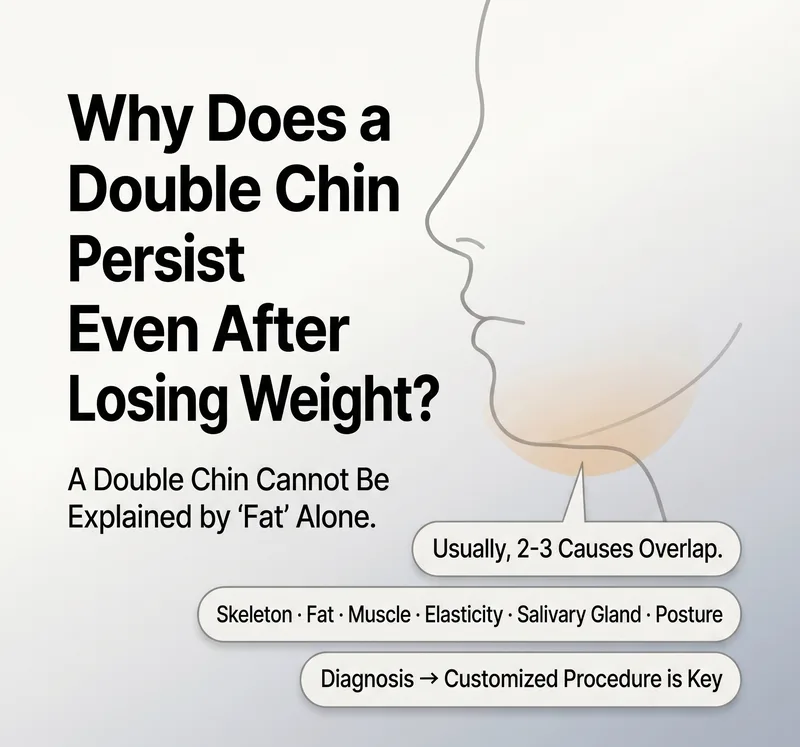
One Symptom, Three Different Causes
Double chin is one of the most common facial concerns, yet many patients don't realize it has multiple distinct causes. Two patients can both have a double chin, but require completely different treatment approaches. Treating the wrong cause wastes time and money. Understanding your specific type is the critical first step toward effective improvement.
The double chin you see in the mirror can result from fat accumulation, skin laxity, or skeletal structure—and often a combination of these factors. Each requires a different therapeutic strategy to achieve a good outcome.
Type 1: Fatty Double Chin (Submental Fullness)
The appearance: Your chin area appears puffy and full. You have a distinct fold or bulge under your chin, even if your weight is normal. The problem is most noticeable when you turn your head to the side or tilt your head downward. Sometimes you can pinch the tissue under your chin and feel the soft, fatty tissue.
Why it develops: Some people are genetically predisposed to accumulate fat in the submental region (under the chin). As we age, gravity worsens this accumulation. Weight gain can exacerbate it, but even slim individuals can have fatty double chins due to genetics. This type of double chin is essentially localized fat that your body preferentially stores in that area.
The effective approach: Fatty double chins respond best to fat-dissolving treatments or lipolysis. These work by breaking down the fat cells in the submental region, allowing your body to naturally clear them. Lifting treatments alone won't solve this because the problem is excess fat, not loose skin. Similarly, if you underwent surgery to remove the fat, your skin would likely look loose afterward. The non-surgical fat dissolution approach is gentler and often more practical.
Type 2: Sagging Double Chin (Skin Laxity)
The appearance: You don't necessarily have excess fat, but your skin under the chin is slack and droops. Your jawline is blurry and undefined. When you tilt your head back, the excess skin bunches up noticeably. If you manually tighten the skin under your chin with your hands, you can see how much better you'd look.
Why it develops: As we age, collagen and elastin degrade, and our skin loses elasticity. The skin under the chin, which is relatively thin and gets a lot of motion from jaw and neck movement, is particularly vulnerable to this degradation. The result is slack, drooping skin that creates the appearance of a double chin even without excess fat.
The effective approach: This type needs lifting and skin tightening, not fat removal. Ultherapy, radiofrequency treatments, and similar lifting technologies work by stimulating collagen production and tightening the dermis. By restoring skin elasticity and lifting the descended tissue, you improve the jawline definition and reduce the sagging appearance. Adding volume through dermal fillers can provide additional jawline definition if the skin laxity is severe.
Type 3: Skeletal Double Chin (Bone Structure)
The appearance: Your double chin appears primarily as an underdeveloped or recessed chin bone. Even if your skin is tight and you have minimal fat, the doubling appearance is still present because of bone structure. Your natural chin point is not as forward-projected as typical proportions suggest it should be. The underlying bone structure creates a shadow under the chin that appears as fullness.
Why it develops: This is largely genetic—your natural skeletal structure creates less definition in the chin-neck angle. It's not a result of aging or weight gain but rather your inherent anatomy. Some people are born with this structure; it doesn't worsen significantly with age unless accompanied by skin laxity.
The effective approach: Skeletal issues require different thinking because there's no fat to remove and often not much loose skin to tighten. The solution lies in creating the optical illusion of a stronger chin through strategic volume restoration and careful jawline contouring using dermal fillers. By adding volume to the chin point and along the jawline, you create better definition and improve the chin-neck angle. This changes the shadow pattern and creates the appearance of a more defined profile.
The Mixed Type: When Multiple Factors Combine
Most double chins involve a combination—some fat, some skin laxity, possibly some skeletal component. The treatment challenge becomes determining which factor is dominant and addressing them in the right sequence.
For example: You might have 50% sagging skin + 40% fat + 10% skeletal structure. In this case, you'd want to start with lifting to restore skin tone and tighten, then add fat dissolution to address the fatty component. Finally, strategic volume can enhance chin definition if the previous treatments leave you wanting more definition.
Or you might have 60% fat + 30% sagging + 10% skeletal. Here, you'd prioritize fat dissolution first, which might also improve the appearance of laxity by reducing the weight pulling skin down. Then lifting can tighten remaining loose skin, and fillers add final definition if needed.
How to Identify Your Double Chin Type
The Pinch Test: Gently pinch the tissue under your chin. Is there significant fatty tissue you can grab? That suggests a fatty component. If you pinch and there's not much tissue, the problem is more likely laxity.
The Weight History: Has your double chin always been present, even at lower weights? That suggests genetics or structure. Did it develop or worsen with aging or weight gain? That suggests fat or laxity, or both.
The Head Tilt Test: Tilt your head back. Does the fullness significantly improve? That suggests a large structural component. Does it remain prominent? That suggests fat or the area is mostly lax skin.
The Skin Quality Test: Does the skin under your chin feel firm and tight, or does it feel slack? Firm skin without excessive fat points toward a structural issue. Slack skin points toward laxity. Both slack skin and noticeable fat points toward a combination type.
Why Professional Assessment Matters
These self-tests give you useful information for your consultation, but professional assessment is more accurate. A dermatologist can palpate the tissue, assess skin quality, evaluate bone structure, and determine the percentage breakdown of each factor. This precise diagnosis becomes your roadmap for achieving good outcomes without wasting time on treatments that won't effectively address your primary problem.
Frequently Asked Questions
- What causes a double chin?
- Double chins fall into three categories: fat accumulation, skin laxity, and skeletal recession. Fat type involves excess submental fat, laxity type stems from reduced skin elasticity, and skeletal type results from chin bone recession.
- How is double chin treatment tailored to the cause?
- Fat-type is approached by reducing the fat layer, for example with a lipolysis injection; laxity-type by tightening with Ultherapy or Density; skeletal-type by supporting the chin with filler. ABLE Dermatology does not perform liposuction, thread lifting or implant placement. Many patients have combined types requiring accurate diagnosis.