

ABLE Dermatology does not perform thread lifting. The comparison below is about which layer each approach acts on; what we work with are energy-based devices and injectables.
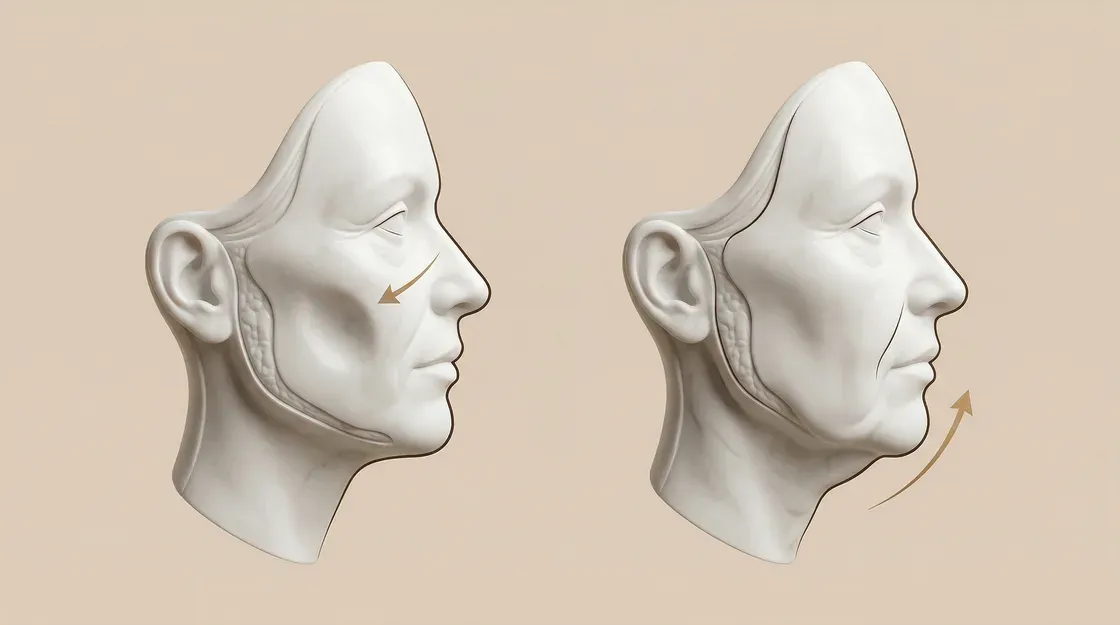
Facial Sagging Has Two Distinct Causes, Not Just One
When you look in the mirror and notice changes to your face, you might describe it simply as "sagging." However, what appears to be one problem is actually two completely different conditions hiding beneath the surface. Some people feel their face looks "hollow" because the volume has diminished, while others notice their "skin is stretching and drooping." Medically speaking, these arise from opposite mechanisms and require opposite treatment approaches.
Understanding this distinction is the crucial first step to successful lifting treatment. The same Ultherapy, the same filler—these can produce dramatic improvements in one patient but actually make things worse in another. This is why accurate diagnosis matters more than the specific treatment name.
The First Type: Volume Loss Sagging
Volume loss sagging develops as we age and the facial fat pads gradually diminish and shrink. Your face isn't a single solid structure but rather multiple layers of tissue. The facial fat pads play a crucial role in maintaining facial fullness and elasticity. When this fat decreases with age, the facial surface sinks inward, creating a hollowed appearance.
The hallmark of volume loss sagging is sunken cheeks. When the fat beneath the cheekbones disappears, it creates an empty space that makes people say, "My face looks thin and hollow." This is often accompanied by hollowing under the eyes, indentation at the temples, and deepening nasolabial folds. The common feature is shadows appearing where fat once was.
Many people make a critical mistake here. Believing their face is sagging, they repeatedly undergo tightening procedures (Ultherapy, Thermage, microneedling, etc.). But when you already lack volume, pulling the skin tighter makes it look even more hollow—like how someone who has lost significant weight can appear skeletal when their skin is tightened. This is why many patients receive expensive lifting treatments multiple times without satisfactory results.
What volume loss sagging actually needs is filling, not tightening. The lost fat must be replenished. This is where fillers (hyaluronic acid) and collagen stimulators (Sculptra, Juvelook Volume) come in. Fillers provide immediate volume, while collagen stimulators stimulate your skin to naturally produce more collagen over time for long-lasting improvement. After appropriately restoring lost volume, gentle lifting can be added as a supporting treatment if needed.
The Second Type: Skin Laxity Sagging
Skin laxity sagging operates through an entirely different mechanism. It occurs when collagen and elastin—the proteins that maintain skin elasticity—decrease. The skin loses its ability to snap back and gradually droops under gravity rather than simply losing volume.
The characteristic signs include double chin formation as the skin beneath the chin loses elasticity and sags downward. The jawline becomes unclear, and cheeks seem to slump downward like "holding a watermelon." Marionette lines from the corner of the mouth to below the chin become prominent. These all share the common feature of skin descending and sagging.
A common mistake with skin laxity sagging is simply continuing to add filler upon filler. "I have sagging, so I need to plump my cheeks," people think. But adding weight to already-inelastic skin makes sagging worse, like how adding sand to a stretched balloon makes it sag further. This is why some patients receiving copious filler actually feel their face looks more sagged.
What skin laxity sagging needs is lifting. The drooping skin must be lifted, and elasticity must be restored. Modern dermatology offers effective solutions. Ultherapy (HIFU) directly stimulates the SMAS layer for powerful lifting. Radiofrequency treatments generate collagen at different depths, gradually tightening skin. Microwaves work deep in the subcutaneous layer to restore elasticity and provide internal lifting. These technologies target the skin's multiple layers simultaneously for effective improvement.
Most Patients Have a Combination of Both
If you're wondering which type applies to you, the truth is that purely one or the other is quite rare. Most patients actually experience a combination of both.
Consider a typical 50-year-old patient: their cheekbones appear hollow (volume loss) so they need filler, but their jawline is blurred and they have a double chin (skin laxity) so they need lifting too. Another 60-year-old has significant overall sagging but still retains some fat pads—proceeding with lifting alone might make their face look too hollow. In cases like this, lifting combined with strategic volume restoration is necessary.
Therefore, the key is accurate diagnosis. Determining which factor is primary, and in what proportion, allows us to determine the correct treatment sequence and balance. This is precisely why board-certified dermatologists are invaluable.
At ABLE Dermatology, we approach combined sagging through comprehensive evaluation. We consider skin thickness, the volume and location of fat pads, the degree and direction of sagging, and skin quality. We then design the optimal combination of volume restoration and lifting specific to each patient. For one patient, 60% filler + 40% lifting is the answer; for another, 70% lifting + 30% filler is correct.
Getting the First Step of Sagging Treatment Right
Facial sagging never stems from just one cause, and it's never treated with just one approach. Identical procedures with identical amounts of filler produce dramatically different results depending on the individual situation. This is why many people receive multiple treatments at different clinics yet remain unsatisfied.
The first critical step in sagging treatment is therefore accurately understanding and diagnosing "why is my face sagging?" If your sagging appears as "hollow and thin," fillers and collagen stimulators will be your primary solutions. If your sagging is "stretched and drooping," Ultherapy, RF, and radiofrequency will be more effective. And in most cases involving combined sagging, the answer lies in integrating both approaches into one cohesive treatment plan based on precise diagnosis.
When consulting a dermatologist, don't stop at hearing "you have sagging." Specifically ask: "What is the primary cause of my sagging?" The answer will determine whether your lifting treatment succeeds or falls short.
Frequently Asked Questions
- How do you tell if facial sagging is from volume loss or skin laxity?
- Volume loss presents as hollowing in the temples, cheeks, and jawline, while skin laxity shows as nasolabial folds and jowling. Treatment approaches differ fundamentally, making accurate diagnosis essential.
- What are the treatments for volume loss vs skin laxity?
- Volume loss is addressed with fillers or fat grafting, while skin laxity requires tightening procedures like Ultherapy or thread lifts. Combined cases need a staged approach using both strategies.
Want to learn more about sagging treatment?
Sagging & Lifting Treatment Details Schedule Consultation