

Cheek hollowing after Ulthera is not just about tip depth
The commonly encountered explanation for cheek hollowing after Ulthera is that "the 3.0mm tip was shot too shallow, damaging the fat." However, this is only half the story. In reality, cheek hollowing can occur even when the 4.5mm tip accurately targets the SMAS.
Cheek hollowing appears in two main locations — the lateral cheek (over the masseter) and the anterior cheek (below the zygoma, beside the nose) — and the mechanisms at work in these two areas are entirely different. Because the layer structure differs by region even within the same face, the same 4.5mm tip produces completely different effects in the lateral cheek versus the anterior cheek.
Anatomical differences between the lateral and anterior cheek
The layer structure of the lateral cheek is: skin → subcutaneous fat → SMAS/platysma → premasseter space (the space between SMAS and masseter fascia) → masseter fascia → masseter. The key feature is that no deep fat compartment exists below the SMAS. Instead, a potential space called the premasseter space lies between the SMAS and the masseter fascia.
The layer structure of the anterior cheek (deep cheek) is entirely different: skin → subcutaneous fat → SMAS → deep medial cheek fat/SOOF → periosteum. In this region, a clearly defined deep fat compartment exists. Under the facial fat compartment classification established by Rohrich (2008), it constitutes the core volume structure of the medial midface. This deep fat serves as a "pedestal" that supports the superficial fat from below.
Lateral cheek hollowing — Premasseter space expansion and vector change
The essence of lateral cheek hollowing is not damage to the SMAS itself, but rather that the contraction force acts in the wrong direction.
According to Mendelson's anatomical studies (2008, 2013), the premasseter space is a membrane-bounded gliding plane. In its normal state, when contraction force is applied to the SMAS, the masseter ligaments anchor anteriorly, causing the SMAS to be pulled upward — this is the desired lifting effect.
However, when the premasseter space has expanded and the ligaments have weakened due to repeated masseter Botox, aging, or prior jaw contouring surgery, the same contraction force follows the path of least resistance, pulling the SMAS inward into the already-empty space. Subsequently, collagen remodeling proceeds at the wrong position over 3 to 6 weeks, forming secondary adhesions that fix the hollowing in place.
Anterior cheek hollowing — Deep fat loss pathway (Pseudoptosis)
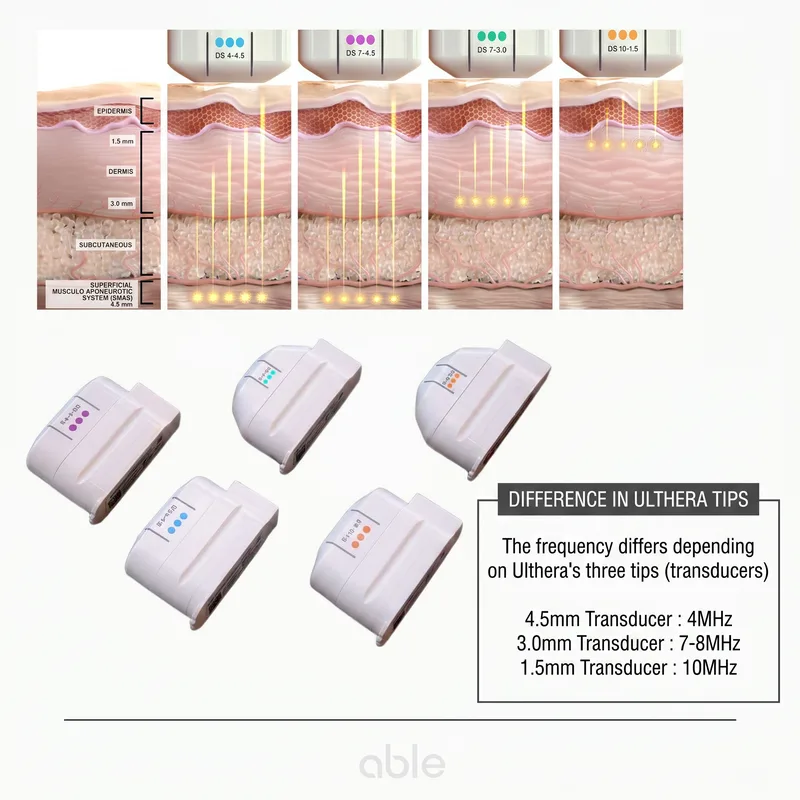
An entirely different mechanism operates in the anterior cheek. At clinical energy levels (1.2J or below), Ulthera forms only small scattered TCPs (thermal coagulation points) rather than full thermal columns, but a thermal gradient zone inevitably forms around each TCP.
The key point is that the collagen denaturation threshold (approximately 60°C) and the adipocyte apoptosis threshold (approximately 56°C) differ. Within a 1–2mm radius of the TCP, temperatures of 56–58°C are insufficient for collagen denaturation but are enough to activate the adipocyte apoptosis pathway. An in vivo study by Choi et al. (2023) confirmed that this effect persists up to 14 days post-treatment.
Furthermore, research by Cho et al. (2023) demonstrated that thinner skin and fat layers cause the TCP to form deeper and more irregularly than the set target depth. Therefore, in patients with less facial volume, the thermal gradient zone is more likely to reach the deep fat compartments.
When deep fat is lost, the superficial fat loses its support and sags downward, resulting in pseudoptosis. Even when the SMAS contracts successfully, if deep volume is simultaneously lost — like tightening an empty drum — the surface appears taut but the absence of volume creates an aged appearance.
Risk screening — Pre-treatment palpation assessment
Identifying high-risk patients for Ulthera cheek hollowing is the starting point of treatment safety. Caution is warranted when the following signals are present.
| Risk Signal | Related Mechanism |
|---|---|
| History of repeated masseter Botox | Lateral cheek — premasseter space expansion |
| Pre-existing cheek hollowing | Lateral + anterior cheek — deep fat loss + space expansion |
| Thin face with minimal fat layer | Anterior cheek — thermal gradient zone reaching deep fat |
| Firmness on lateral cheek palpation | Lateral cheek — premasseter space adhesion/fibrosis |
| History of jaw contouring surgery | Lateral cheek — structural alteration of space |
| Reduced fat near nasolabial area | Anterior cheek — deep fat compartment loss |
Practical palpation techniques include the pinch test (pinching and lifting the lateral cheek skin over the masseter to assess space availability), the gliding test (pushing the lateral cheek skin upward to evaluate SMAS mobility), and bilateral symmetry comparison (if one side feels firmer, this signals asymmetric adhesion).
Solution — Principles of sub-SMAS volume restoration
The core strategy for preventing hollowing in patients with expanded premasseter space is to fill the sub-SMAS space with volume, thereby eliminating the space into which the SMAS could collapse.
Sub-SMAS volume restoration works through three mechanisms. First, the physical resistance line is restored because there is no longer an empty space for the SMAS ceiling to collapse into. Second, it serves as an artificial anterior boundary that compensates for the weakened masseter ligaments. Third, sub-SMAS volume pushes the SMAS upward from below, passively setting the lifting vector in the upward direction — the tenting effect.
What to fill — Product comparison
| Product | Collagen Induction Pathway | Contractile Collagen Risk | Immediate Volume | Sub-SMAS Suitability |
|---|---|---|---|---|
| HA Filler | None (mechanical volume) | None | Immediate | 1st choice |
| CaHA (Radiesse) | Ca²⁺ direct fibroblast activation | Low | Immediate (gel carrier) | 2nd choice |
| PLLA (Sculptra) | TGF-β/Smad pathway | High | None | Requires ESWT combination |
| PN/PDRN (Rejuran, etc.) | A2A receptor → physiological collagen synthesis | Low (anti-fibrotic) | Minimal | Auxiliary option |
HA filler is the first choice because it carries no risk of contractile collagen formation, provides immediate volume that blocks the SMAS collapse space right away, and can be reversed with hyaluronidase if problems arise. When PLLA is used, combining it with ESWT (extracorporeal shockwave therapy) to suppress the TGF-β1 pathway and counteract contractile collagen formation is beneficial.
Integrated clinical approach — High-risk patient protocol
Step 1: Pre-treatment ESWT (Extracorporeal Shockwave Therapy) — Release existing adhesions and restore SMAS mobility.
Step 2: Ulthera treatment — Filling volume first and then performing Ulthera requires an interval of 1 month or more, so Ulthera is performed first.
Step 3: Sub-SMAS volume restoration — Volume is supplemented immediately after Ulthera. HA filler is the first choice, CaHA the second.
Step 4: Follow-up ESWT sessions — Repeated shockwave therapy during the 3–6 week collagen remodeling period prevents pathological adhesion from forming at incorrect positions.
Frequently Asked Questions
- Can cheek hollowing after Ulthera recover naturally?
- If the hollowing is caused by temporary post-treatment swelling reduction, it will resolve naturally within 1–2 months. However, actual fat loss due to adipocyte apoptosis does not recover on its own. Dead adipocytes do not regenerate, so sub-SMAS volume restoration procedures are needed to compensate.
- Is Ulthera safe for thin faces?
- It can be performed, but standard protocols carry significant risk. Thinner fat layers increase the likelihood that the TCP thermal gradient zone reaches deep fat compartments, raising pseudoptosis risk. A customized approach — either preceding sub-SMAS volume restoration or conservative energy settings — is necessary.
- Is Ulthera safe after frequent masseter Botox?
- Repeated masseter Botox is a major risk factor for premasseter space expansion. With the space enlarged due to masseter atrophy, the likelihood of inward SMAS collapse during contraction is higher than average. It is safer to consider sub-SMAS volume restoration in conjunction with Ulthera.
- Is cheek hollowing permanent?
- Lateral cheek hollowing is primarily caused by secondary adhesion at incorrect positions, and can be improved with repeated ESWT sessions and sub-SMAS filler supplementation. Anterior cheek hollowing involves loss of the adipocytes themselves, making natural recovery difficult — the treatment direction is volume restoration with filler.
- Can ESWT cause cheek hollowing?
- No. ESWT operates via mechanical pressure waves and generates no thermal energy. Its physics are fundamentally different from HIFU's thermal fat injury mechanism. ESWT does not alter fat compartment volume — it targets only fascial collagen reorganization.