

ABLE Dermatology does not perform thread lifting. The comparison below is about which layer each approach acts on; what we work with are energy-based devices and injectables.
Why a Pain Clinic Device Came to Dermatology
Extracorporeal Shockwave Therapy (ESWT) originated in the 1980s from ESWL (Extracorporeal Shockwave Lithotripsy) for kidney stone fragmentation. During the stone-breaking process, researchers observed that regenerative cellular responses were occurring in the bones and soft tissues along the shockwave path — and this discovery eventually led to its use in orthopedic pain treatment.
The energy levels used in aesthetic dermatology (0.01–0.2 mJ/mm²) fall into a completely different category from urology (0.5–2.0 mJ/mm²) or orthopedics (0.1–0.4 mJ/mm²). They share the same name but serve different purposes at different energy levels.
While urological ESWL aims at tissue destruction, dermatological ESWT aims to induce regeneration through mechanical stimulation of cells. This is called mechanotransduction — and it is the most important starting point for understanding cosmetic extracorporeal shockwave therapy.
The first commercial application in the aesthetic field occurred in 2004 when Swiss company Storz Medical commercialized the concept of AWT (Acoustic Wave Therapy) for cosmetic use, and today's aesthetic ESWT market traces its roots to this concept.
Four Types of Shockwave Generation
Devices grouped under the term "shockwave" in the market actually use one of four different generation methods. This difference is the starting point that determines each device's clinical characteristics.
| Method | Principle | Penetration Depth | Focal Zone | Characteristics |
|---|---|---|---|---|
| Electrohydraulic (EH) | High-voltage underwater electrode discharge → ellipsoidal reflector focusing | ~60 mm | ~12 mm | High output but low reproducibility; suitable for stone fragmentation |
| Electromagnetic (EM) | Coil current → metal membrane vibration → acoustic lens focusing | ~35 mm | ~4 mm | High and uniform energy reproducibility; efficient for SMAS stimulation |
| Piezoelectric (PZ) | Hundreds of crystal hemispheres arranged → focal superposition | ~20 mm | ~3 mm | Short rise time and sharp pressure peak; advantageous for precise targeting |
| Radial | Compressed-air projectile impact → surface radial diffusion | Surface | No focal point | Suitable for broad superficial areas (e.g., cellulite) |
From the perspective of facial aesthetics, greater depth is not inherently better — what matters is depth appropriate for facial anatomy (dermis to SMAS, approximately 5–15 mm). No single technology is universally superior; it is a question of which characteristics suit which clinical situation.
Four Devices in the Market — What's Different
The four extracorporeal shockwave devices most commonly referenced in Korean dermatology clinics are Storz, Revinas, Olewave, and Vchin. They differ in generation method, and accordingly show different clinical strengths in different areas.
Storz Medical (Switzerland) — The standard reference for cosmetic ESWT and the device with the richest clinical evidence. The company that first commercialized the AWT concept in 2004, with a lineup combining focused EM and radial technology. It holds solid EBM data including a cellulite RCT (Schlaudraff et al., 2014), a 333-patient prospective facial lifting study (Kimura & Tanaka, 2020), and a 52-patient retrospective study on facial and subcutaneous fibrosis (Ko & Cho, 2024).
Revinas — An EM-based device following the cosmetic application direction of Storz AWT. It implements the stability and wide focal zone characteristic of EM technology, making it principally well-suited for uniformly stimulating broad fascial areas like the SMAS distributed across the entire face.
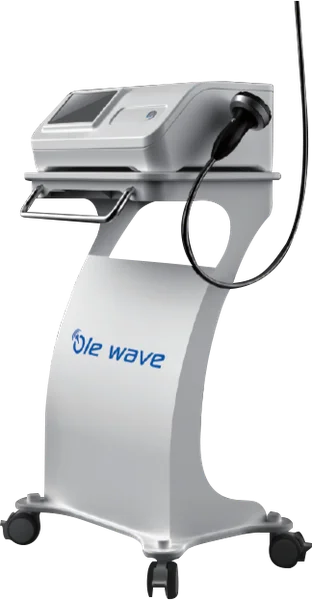
Olewave (Korea) — A PZ Array-based device. Its technical contribution is miniaturizing and optimizing PZ technology — previously available only in large systems for orthopedic rehabilitation or urology — for facial dermatological treatments. Short rise time, sharp pressure peak, and narrow focal zone (approximately 2–3 mm) are the inherent physical characteristics of the PZ method, and more precise mechanical stimulation at acoustic impedance boundaries is anticipated.
Vchin (Switzerland) — A focused ESWT device with FDA 510(k) Clearance. Its differentiator is a systematized three-stage facial protocol (low energy lymphatic → medium energy collagen → high energy adhesion).
Clinical Situation-Based Device Selection
| Clinical Situation | Suitable Method | Representative Device |
|---|---|---|
| Cellulite / lymphatic circulation (broad area stimulation) | Radial | Storz D-ACTOR |
| Uniform SMAS fascial stimulation | Electromagnetic (EM) | Revinas, Storz DUOLITH |
| Localized adhesion / fibrosis breaking | Piezoelectric (PZ) | Olewave |
| Wounds / scars (strong clinical EBM) | Focused EM + Radial | Storz DUOLITH |
Within the same energy range, reports suggest that EFD (energy flux density) and total dose are more decisive than differences in generation method, and mechanotransduction as a mechanism is understood to operate identically regardless of generation method.
Working Without Heat — The Critical Difference from HIFU
HIFU (Ulthera) concentrates ultrasound energy at a single point to create thermal coagulation zones at 60–70°C (up to 85°C), and as those coagulation zones contract, the lifting effect is produced. It is a treatment that uses intentional thermal injury to contract collagen.
Shockwave therapy, by contrast, is a mechanical stimulus using the positive and negative pressure waveforms of a pressure wave — no heat is generated. This difference is an acoustically established fact.
Shockwave therapy operates on two physical principles. First, energy is released intensively at the boundaries between tissues with different acoustic impedances (dermis–fat, fat–SMAS, SMAS–muscle). Second, that mechanical stimulus is converted into a mechanotransduction signal through PIEZO ion channels in the cell membrane, leading to upregulation of growth factors such as VEGF and FGF-2.
Because there is no thermal injury, the risk of side effects such as fat atrophy is principally lower, and it carries clinical significance as a complementary application for adhesions or fibrosis that may form after HIFU treatment.
Synergy with Ulthera — Combination Protocol
Synergy with HIFU treatments like Ulthera is one of the clearest clinical areas for shockwave lifting.
Shockwave applied before Ulthera: fibro-septae adhesions in the premasseter space are released and SMAS mobility is restored. When HIFU is applied in the presence of fascial adhesions, the contractile force may not act in the desired direction (upward), so releasing adhesions first becomes the first step in preserving the directionality of HIFU contraction.
Shockwave applied after Ulthera: immediately after HIFU, the TGF-β/Smad pathway is transiently activated, and if not properly regulated, pathological adhesions or contractile collagen may re-form. Low-energy shockwave has been reported to act in a direction that calms this pathway.
Summarized as a clinical flow: ESWT (adhesion release) → HIFU (SMAS contraction) → ESWT (prevention of adhesion re-formation) forms the combination protocol.
Collagen Stimulator Nodule Management
After collagen stimulator treatments such as Juvelook, Sculptra, or Radiesse, particles may clump together or non-inflammatory nodules may form. Unlike regular fillers that dissolve with hyaluronidase, these nodules are not broken down by enzymes and are difficult to manage — and shockwave therapy is applied in this area.
Two mechanisms work together. One is physical dispersion — mechanical vibration scatters clumped microparticles and redistributes them evenly. The other is TGF-β1 inhibition — reported to contribute to reducing myofibroblast hyperactivation and contractile collagen formation.
At the stage of breaking down already-formed non-inflammatory nodules, a technique of first injecting normal saline into the nodule interior before applying shockwave is used. This exploits the acoustic impedance difference between water (1480 kg/s·m²) and the particles to maximize boundary interface energy.
Fascial Adhesion and Scar Adhesion Applications
Adhesion refers to a state in which internal tissue layers have become bound together, restricting movement. Fascial adhesion refers to the firm attachment of connective tissue above and below the SMAS layer; phenomena such as cheek sagging after jaw botox or cheek hollowing after Ulthera also have adhesion changes in this space as an underlying factor.
The characteristic of shockwave therapy to automatically concentrate energy at boundaries with large acoustic impedance differences is meaningful here. Because the impedance difference between fibrotic tissue and normal tissue is large, shockwave acts selectively on adhesion sites.
Clinical evidence for facial and subcutaneous fibrosis includes Ko & Cho (2024), a 52-patient retrospective observational study reporting outcomes of an average 8 sessions applied to patients with facial fibrosis occurring after surgery, liposuction, filler, thread lifting, or trauma.
Acne scar adhesions are approached using the same principle. When the base of a scar is attached deep in the dermis, surface treatments alone have limitations. In an animal model study by Zhao et al. (2018), low-energy shockwave (0.1 mJ/mm²) was confirmed to significantly reduce scar height and fibroblast density.
Post-Skinbooster/Rejuran Management
Small surface elevations (embossing, papules) visible on the skin after skinbooster or Rejuran treatments are normal reactions, but if excessively large or persisting for several days, they can cause discomfort in daily activities. When shockwave therapy is added, the absorption rate has been reported to accelerate.
One mechanism is physical dispersion of the injected material, and the other is lymphatic and blood flow stimulation. Low-energy shockwave activates lymphatic vessel function through the VEGF-C/VEGFR-3 pathway, as confirmed in animal models (Bae et al., 2010). However, since the injected material should only be dispersed — not broken down — low energy settings are used.
Contraindications and Precautions
Shockwave lifting also has clear contraindications and precautions.
| Category | Details |
|---|---|
| Contraindications | Eye area, malignant tumor sites |
| Caution Required | Coagulation disorders or patients taking high-dose anticoagulants (increased risk of bruising and hematoma) |
| Protective Measures | Teeth and dental implant areas — risk of pain and damage due to acoustic impedance differences; maintain distance using gauze or air inflation in the cheek |
| Not Applied | During pregnancy (insufficient fetal safety data) |
Frequently Asked Questions
- Can shockwave lifting alone produce a lifting effect?
- As a standalone treatment, direct tissue elevation has its limits. Shockwave therapy primarily works by inducing tissue remodeling and releasing adhesions, and is best utilized as a synergy treatment combined with HIFU or thread lifting, where the depth and direction of the effect are significantly enhanced.
- How do I choose between Olewave and Revinas?
- Both are focused devices, but their characteristics differ based on their principles (EM vs. PZ). For areas where broad fascial layers like the SMAS need to be uniformly stimulated, the wider focal zone of EM technology (Revinas) is efficient. For areas where localized adhesions or fibrosis need to be precisely broken, the sharp pressure peak of PZ technology (Olewave) is advantageous.
- Does FDA clearance mean the device's effectiveness is proven?
- FDA 510(k) Clearance held by cosmetic ESWT devices recognizes technological equivalence to previously cleared devices, and many pass with bench tests alone without new clinical RCTs. Clinical efficacy must be evaluated separately through RCT data. Currently, clinical data in the cosmetic ESWT category is concentrated in Storz devices.
- Can collagen stimulator nodules be resolved with shockwave therapy?
- It is a principally applicable area with accumulating clinical reports. However, the approach varies depending on nodule type (inflammatory vs. non-inflammatory), time of formation, and size, so individual clinical assessment is prioritized.
- Can shockwave therapy speed up bruise absorption after a procedure?
- There are reports that low-energy shockwave accelerates bruise absorption, and it is also used in clinical practice. However, it should be avoided at the very early stage when bleeding may still be ongoing (day of procedure), and is typically applied 1–3 days after the procedure.
※ The content of this article is based on current research findings and clinical experience. Applicability and outcomes may vary depending on individual skin condition, treatment history, and underlying medical conditions. Large-scale device-specific RCTs remain to be accumulated for devices other than Storz.
Frequently Asked Questions
- What aftercare and contraindications apply?
- The eye area and any site of malignancy are contraindications. Patients with a coagulation disorder or on high-dose anticoagulants require careful assessment, as the risk of bruising and haematoma is higher. The treatment is not performed during pregnancy, because safety for the fetus has not been established.
Would you like a consultation about shockwave lifting or combination treatments?
Book a Specialist Consultation About Ulthera Treatment